

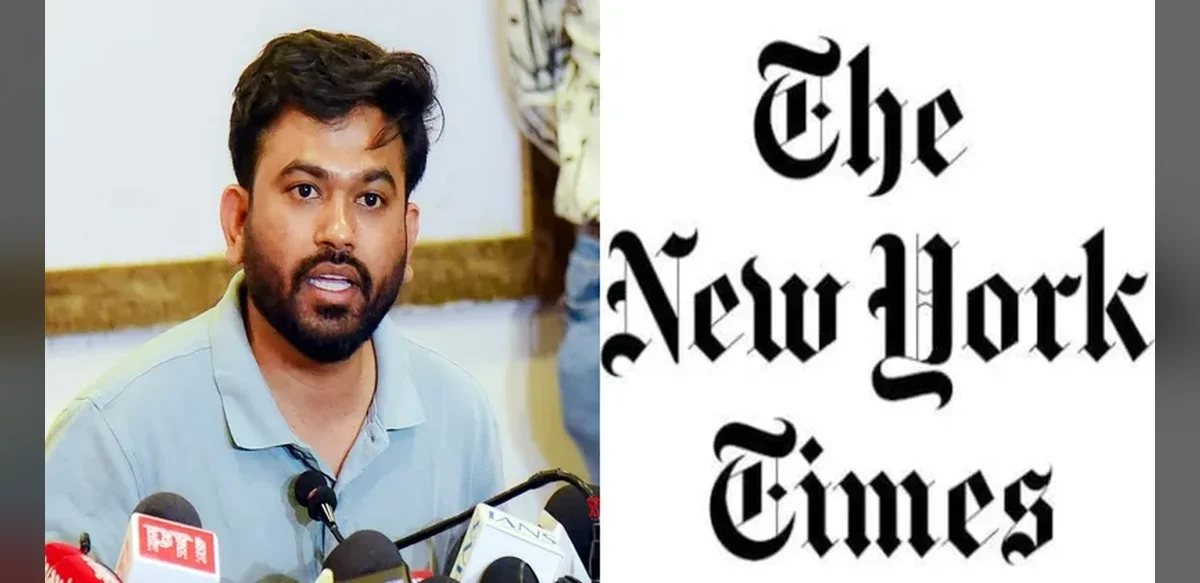
New Delhi: A recent opinion video from the New York Times has drawn attention to the political history and professional background of Abhijeet Dipke, founder of the Cockroach Janta Party. The report highlights his prior connections to the Aam Aadmi Party and his experience in public relations, raising questions about the origins and growth of the group.
The piece suggests that the movement did not arise entirely from unplanned student actions. Instead, it points to organized efforts in digital outreach and messaging that contributed to its quick expansion online. Dipke previously worked as a social media strategist for the Aam Aadmi Party from 2020 to 2023, according to the report. This experience is presented as relevant to understanding how the Cockroach Janta Party shifted from online satire accounts to calls for ministerial resignations.
Observers note that such transitions often follow patterns seen in established political campaigns rather than purely informal youth initiatives. The report also references Dipke’s education, including a master’s degree in public relations from Boston University. It describes how structured approaches to branding, digital tools, and artificial intelligence may have supported the campaign’s scaling.
Questions are raised about whether the group’s reach was primarily organic or influenced by professional communication methods. Follower counts on social platforms are mentioned, though the report notes a lack of independent verification for widespread ground-level activity. The evolution from casual online content to targeted strategies aimed at easing entry into political discussions through memes is also examined.
Overall, the New York Times feature explores whether the Cockroach Janta Party represents an independent youth voice or operates with elements of managed political communication. It places the movement’s development in the context of Dipke’s earlier roles and training, prompting further discussion on the balance between grassroots claims and strategic planning.
The coverage comes amid ongoing debates about the nature of student-led initiatives and their potential ties to larger political structures. Analysts suggest that similar scrutiny could apply to other emerging groups using digital platforms for mobilization. The report stops short of definitive conclusions but provides details that invite readers to consider multiple factors behind the party’s rapid profile.
Public reactions have varied, with some viewing the exposure as a necessary check on narratives of spontaneity while others defend the movement’s independence. The New York Times piece adds to a broader conversation about transparency in political organizing and the role of prior affiliations in shaping new entities.
Further reporting may be needed to assess the extent of active participation beyond online metrics. In the meantime, the focus remains on how professional backgrounds and communication expertise intersect with claims of neutral, student-driven activism in contemporary Indian politics.


