


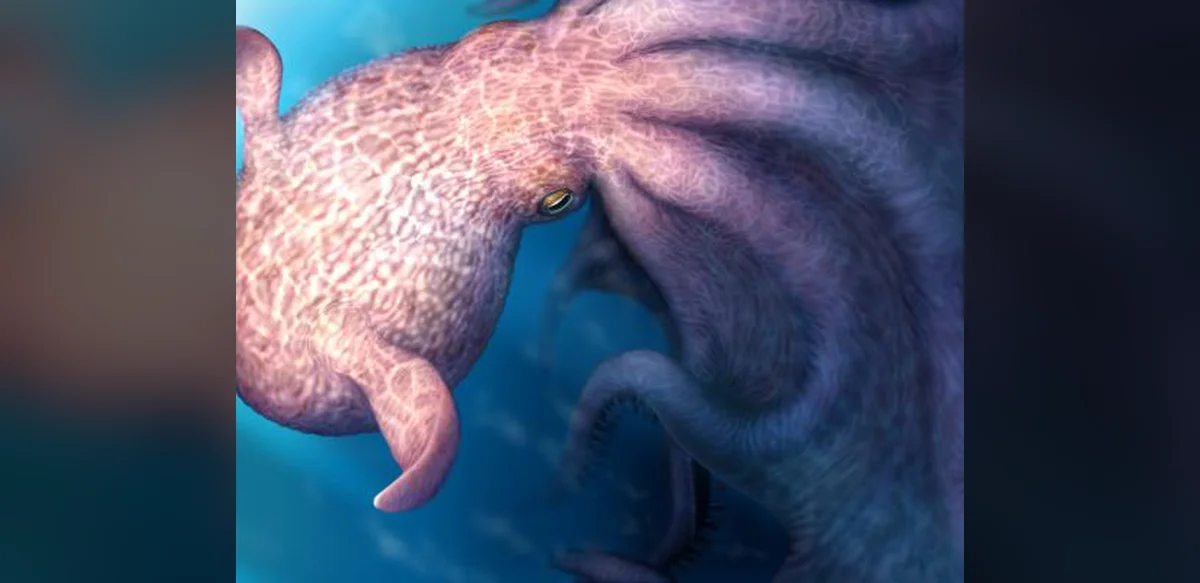
Research indicates that enormous octopus-like creatures, resembling the mythical kraken, were among the top predators in Cretaceous seas, employing strong beaks to shatter the bones of their victims. Examination of recently discovered fossils shows that certain ancient octopus species grew up to 19 meters long, potentially competing with or even hunting dominant predators like mosasaurs and plesiosaurs. Unique damage marks on these massive fossilized beaks, from as far back as 100 million years ago, imply they regularly broke through tough bones and shells.
“This research demonstrates that these were not just oversized versions of today’s octopuses,” stated Dr. Yasuhiro Iba, a paleontologist at Hokkaido University and the study’s lead researcher. “They occupied the highest level of the Cretaceous marine food chain. This alters the perception that large vertebrate predators alone ruled those ancient waters.”
Knowledge of prehistoric octopuses has been limited because their soft tissues seldom fossilize. The investigation focused on detailed studies of fossilized beaks, the sole hard component of an octopus’s anatomy. Scientists reassessed 15 large fossil beaks formerly classified as belonging to vampire squids, determining they actually came from a group of ancient octopus kin called Nanaimoteuthis. Through digital scanning, the team also identified 12 more octopus beaks embedded in Cretaceous sediments, ranging from 72 million to 100 million years old.
One species, Nanaimoteuthis haggarti, possessed a beak exceeding that of the contemporary giant squid, which measures about 12 meters and was previously considered the biggest known invertebrate. By correlating jaw dimensions with body size in modern deep-sea octopuses, researchers calculated that N. haggarti spanned 7 to 19 meters, possibly making it the largest invertebrate ever documented.
Dr. Thomas Clements, a paleobiologist at the University of Reading not connected to the study, commented: “Discovering a beak of this magnitude is truly astonishing. It was an immense creature. I wouldn’t have wanted to swim in those prehistoric seas with them present.”
Contemporary octopuses capture and immobilize prey with their adaptable arms before breaking it apart with their beaks, rather than swallowing it intact. The ancient samples displayed similar wear patterns, indicating comparable hunting methods. In the biggest specimens, the beaks exhibited heavy erosion, with initially pointed edges becoming dull and rounded, along with visible dents and marks.
Iba explained: “It likely employed its extended arms to grab prey and its robust lower jaw to pulverize rigid elements like shells or bones. The significant jaw wear suggests regular handling of tough prey.” This diet probably encompassed bony fish, shelled organisms, and perhaps large marine reptiles such as mosasaurs, which were of similar stature.
Clements added: “In artistic depictions, it’s typically a vertebrate consuming a cephalopod. It’s refreshing to envision an octopus devouring a large vertebrate instead. As someone who studies cephalopods, I’m thrilled to learn of invertebrates that could match vertebrates.”
The beaks showed greater wear on one side, hinting at lateralized behavior. This implies they might have preferred certain arms for tasks, similar to how modern octopuses exhibit handedness, using specific limbs for probing and others for eating. Iba noted: “This reveals that these creatures were not only strong but also exhibited advanced behavioral traits as hunters.”
The results appear in the journal Science.

