


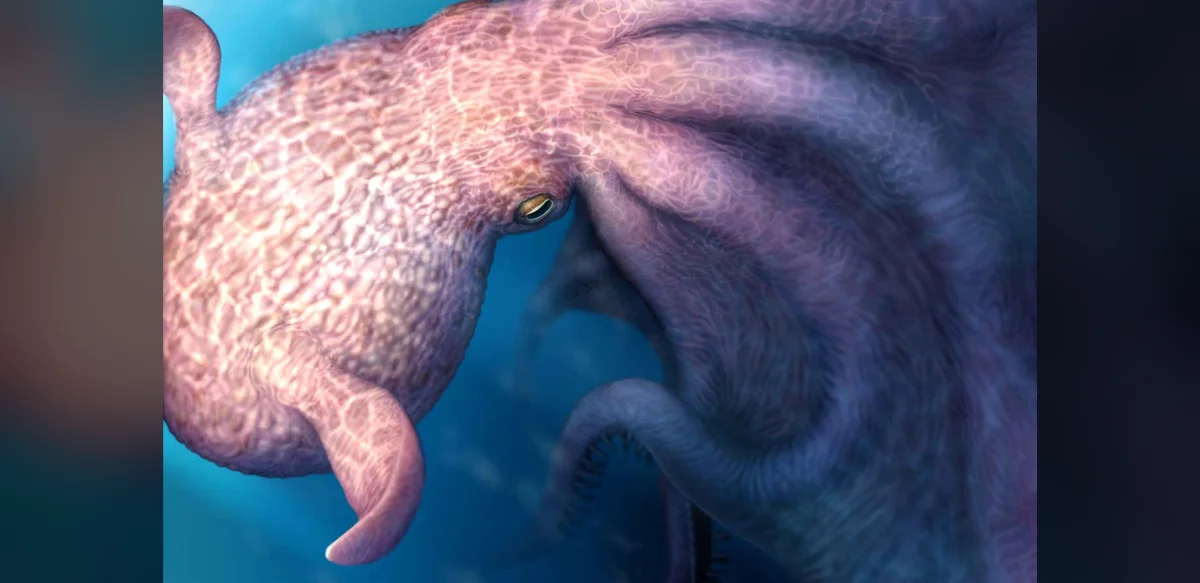
In the Cretaceous period, while dinosaurs dominated the land, the oceans hosted enormous predatory octopuses that could grow up to 19 meters long. Fossil evidence indicates these creatures were likely smart and effective hunters, comparable in size to major predators like sharks and marine reptiles such as plesiosaurs and mosasaurs.
Researchers at Hokkaido University in Japan describe these octopuses as active hunters, similar to orcas or great white sharks among invertebrates. They possessed long arms, strong jaws for breaking tough shells, and possibly sophisticated behaviors.
A team led by Yasuhiro Iba examined 27 large fossilized octopus jaws from 100 million to 72 million years ago, found in Japan and on Vancouver Island in Canada. Twelve of these jaws belonged to previously unknown specimens embedded in rock. Using advanced scanning technology and AI-assisted digital analysis, the scientists revealed the hidden structures.
The jaw, or beak, is typically the only preserved part of an octopus due to its tough chitin composition, while the body is soft and rarely fossilizes.
Earlier studies identified five Cretaceous octopus species, but this research confirms only two: Nanaimoteuthis jeletzkyi and N. haggarti.
The jaws were notably large, especially those of N. haggarti, surpassing those of many modern cephalopods. By comparing jaw size to the mantle length in contemporary long-bodied octopuses, the team estimated N. haggarti’s total length at 6.6 to 18.6 meters, making it one of the largest invertebrates ever.
John Long from Flinders University in Australia notes that gigantism was common in Cretaceous marine life, including sharks, reptiles, and ammonites, due to abundant food sources. He calls the discovery astonishing, highlighting these giant octopuses as dominant ocean predators.
These ancient octopuses superficially resembled modern giant squids, which can exceed 12 meters, and were also open-water swimmers. However, they differed significantly: octopuses use eight arms for capturing and handling prey, unlike squids with eight arms and two tentacles.
Nanaimoteuthis probably grabbed prey with flexible arms and crushed it with powerful jaws, rather than pursuing it like squids.
Analysis of jaw wear and scarring suggests the octopuses fed on hard-shelled animals such as bivalves, ammonites, crustaceans, fish, and other cephalopods. While it’s possible they targeted larger vertebrates, no direct evidence like stomach contents or bite marks exists.
The fossils also show uneven jaw wear, potentially indicating lateralization—preferring one side of the body—which is linked to intelligence in modern octopuses. This trait suggests greater brain complexity and efficient processing, implying these ancient creatures were not only strong but also behaviorally advanced with possible individual preferences.

