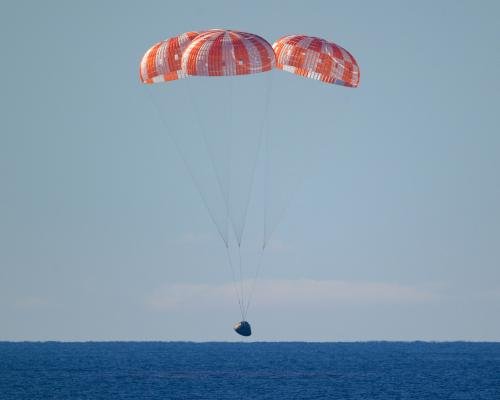
NASA Administrator Jared Isaacman praised the Artemis II astronauts as eloquent representatives of humankind during their journey around the moon. He described them as the first people to venture to the lunar vicinity and return safely since 1972, setting a new record for distance traveled. The atmosphere at Houston’s Johnson Space Center was festive on Friday evening following the Orion capsule’s precise landing in the Pacific after a 10-day trip. The crew, consisting of NASA astronauts Reid Wiseman, Victor Glover, and Christina Koch, along with Canadian Space Agency’s Jeremy Hansen, are scheduled to discuss their observations in an upcoming briefing. A NASA commentator remarked that while the operation has concluded, its impact endures. This accomplishment stands as NASA’s most notable feat in human spaceflight since the Apollo era, reinforcing the United States’ lead in the ongoing competition with China for lunar landings and establishing a lasting presence there. However, as the excitement fades and focus shifts to upcoming obstacles for the Artemis program, internal challenges loom large. Just as the mission launched, President Trump revealed intentions to reduce NASA’s budget by 23 percent, with a 46 percent decrease in space science funding. The program, already delayed and over budget, faces uncertainty in its more complex phases ahead. At a Houston press event after the landing, NASA’s Associate Administrator Amit Kshatriya stated that while access to the moon is now feasible, future tasks will be more demanding. He emphasized the goal of a permanent return, building on efforts from over five decades ago. Experts acknowledge the mission’s importance in advancing prospects for a lunar outpost, confirming the reliability of U.S. technology for deep space travel. Yet, Trump commended the team on his social platform without addressing his proposed severe reductions to the agency. Isaacman endorsed the administration’s plan to cut an additional $6 billion, claiming it would still support key objectives. In contrast, Casey Dreier from the Planetary Society criticized this stance as inconsistent, noting it contradicts recent agency statements and reflects flawed policy. He pointed to Congress’s rejection of a similar proposal earlier this year, predicting a repeat. Dreier described the budget as poorly constructed, including redundant cancellations of already terminated projects and errors in funding requests for telescopes. He expressed disappointment that the mission’s thrill was overshadowed by threats to NASA’s stability.