


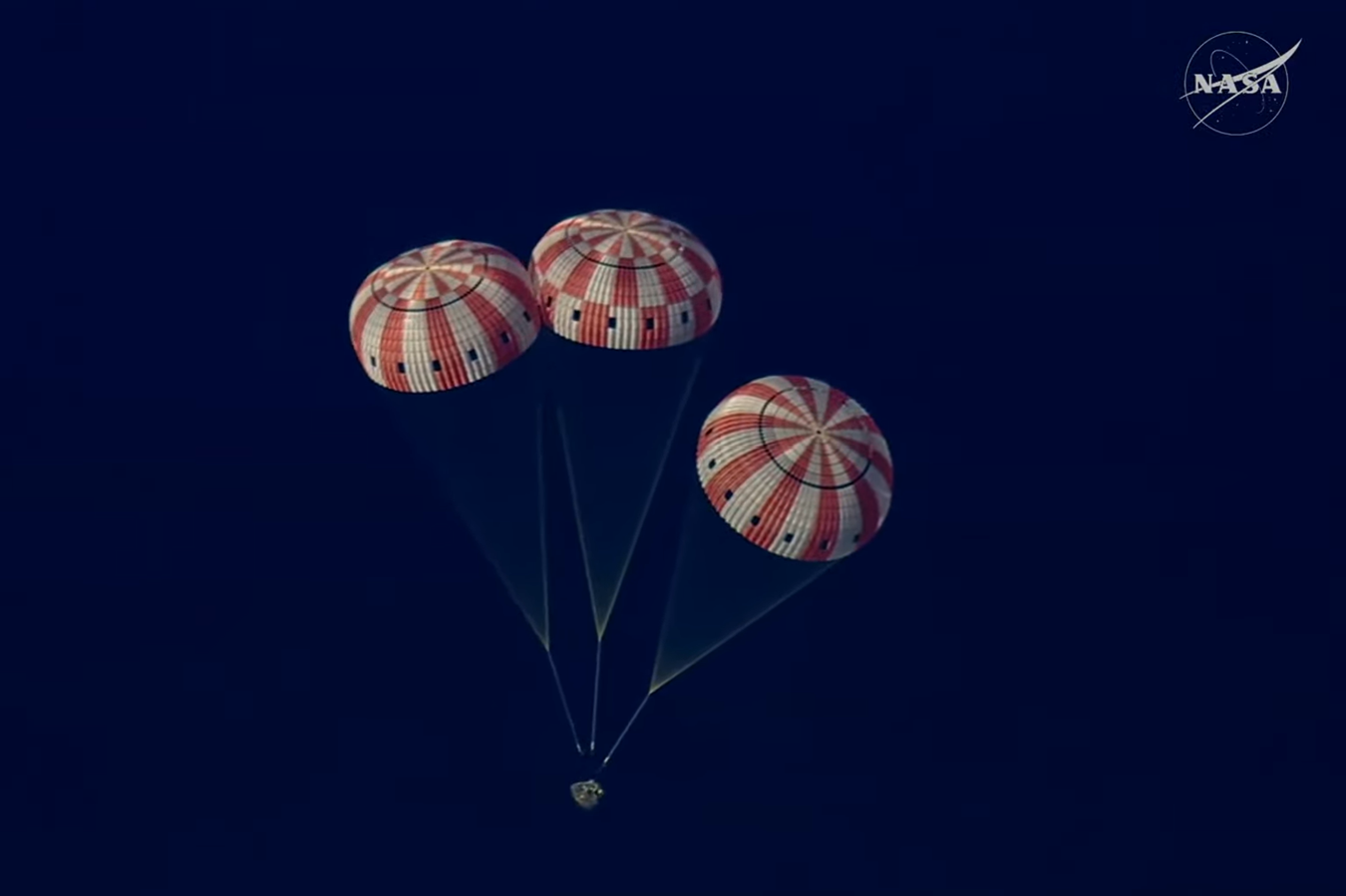
The team aboard NASA’s Artemis II mission has returned safely to Earth, concluding a groundbreaking voyage and paving the way for extended lunar stays.
The mission launched from Cape Canaveral, Florida, on April 1, carrying the astronauts on a path around the moon that took them farther from Earth than any previous human journey. They landed in the Pacific Ocean near California on April 10 via their Orion capsule. Upon arrival, commander Reid Wiseman confirmed that he and his fellow NASA astronauts Victor Glover and Christina Koch, along with Canadian Space Agency’s Jeremy Hansen, were all in good health following atmospheric re-entry. He described the experience as an extraordinary adventure.
This expedition represents the first human trip to the lunar vicinity since the Apollo 17 mission in 1972. The Orion spacecraft reached a maximum distance of 406,771 kilometers from Earth, surpassing the record established by Apollo 13 in 1970.
Primarily designed as a trial run for subsequent moon explorations, Artemis II excelled in its objectives while also accomplishing various scientific aims. Among these were studies of the moon’s surface colors, which appear uniform from a distance but reveal shades of green, brown, and orange upon closer inspection. Such insights aid researchers in understanding the moon’s makeup and evolutionary past, especially on its hidden side, which the crew viewed directly for the first time with human eyes.
When both Earth and the moon appeared in view simultaneously, reflected sunlight from Earth—known as earthshine—overpowered the moon’s subtle tones. Astronaut Christina Koch likened the moon to a light-absorbing sponge that lost its vibrancy and became flat in appearance. The intensity of earthshine through a capsule window was so strong that the team used an extra shirt to block it, leading to suggestions for built-in shades on future spacecraft.
The astronauts captured images and audio notes while observing the lunar landscape, providing detailed accounts of the features below. NASA’s Artemis science coordinator, Kelsey Young, explained during an April 7 briefing that these precise observations could guide upcoming landings and crewed operations to optimize scientific outcomes. They contribute to knowledge about the solar system’s timeline and the development of its inner regions, with the moon serving as a key record of these processes for Earth and nearby areas.
During the spacecraft’s passage behind the moon, the crew observed a unique solar eclipse where the sun seemed smaller than the moon as it vanished below the lunar edge. Wiseman noted the emotional impact of the event, followed by the team’s quick shift to searching for impact flashes—brief bursts of light from meteorite strikes on the dark lunar surface. Detecting these was a mission objective, as it informs risks for surface operations in future outings.
The upcoming Artemis III mission, set for 2027, will not involve a moon landing or orbit but will focus on testing the Orion’s docking capabilities with landers in Earth’s orbit, following recent program adjustments for efficiency. A lunar surface touchdown is planned for Artemis IV in 2028.
These efforts support the broader aim of establishing a ongoing human foothold on the moon. NASA has shifted its strategy from an orbital station to a surface outpost, mirroring ambitions in China’s space initiatives. The vision is for lunar travel to become as commonplace as trips to the International Space Station within decades, potentially even comparable to long-distance air travel. Regardless of the timeline, the visuals from Artemis II have revitalized public interest in the moon.

