


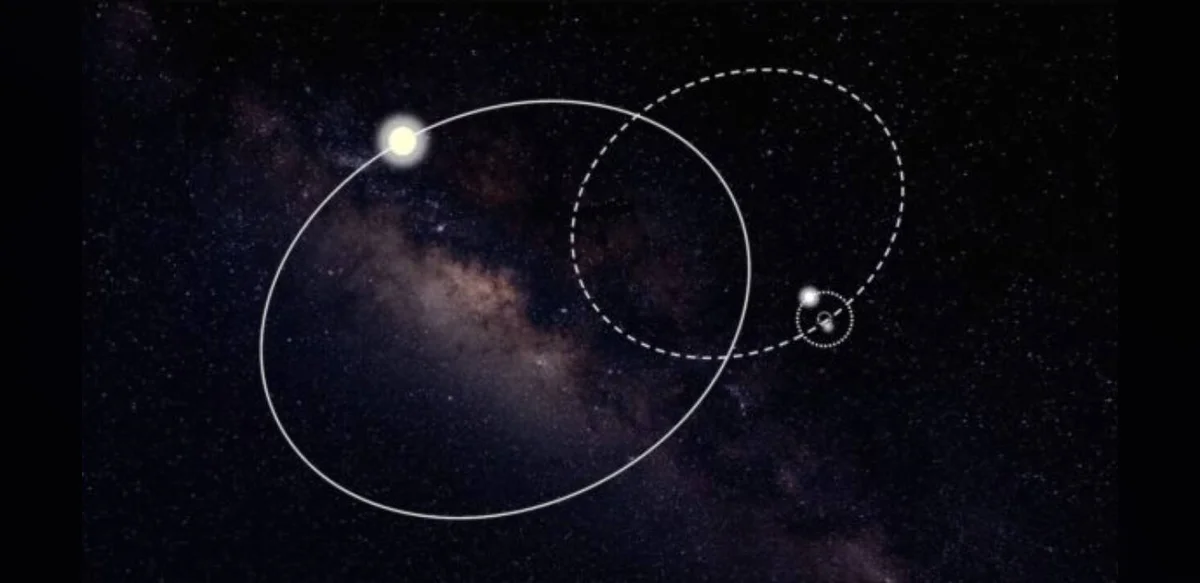
Astronomers have identified an uncommon triple-star system that includes a pulsar rotating once every 3.2 milliseconds. The discovery adds to the limited number of known systems where three stars interact closely with such a rapidly spinning neutron star.
Pulsars form when massive stars exhaust their fuel and collapse, leaving behind dense remnants that emit regular beams of radiation. In this case the pulsar spins exceptionally fast, completing hundreds of rotations each second. Its presence in a triple-star arrangement is considered unusual because most millisecond pulsars are found in binary systems.
The system was detected through radio observations that captured the precise timing signals from the pulsar. Researchers analyzed variations in these signals to determine the gravitational influence of two companion stars. One companion appears to be a white dwarf, while the other is likely a low-mass star still on the main sequence.
Triple-star systems containing pulsars provide valuable opportunities to test theories of stellar evolution and general relativity. The mutual gravitational interactions among the three bodies create measurable effects on the pulsar’s spin and orbital motion. These effects can be tracked over time with high-precision instruments.
The newly found system is located several thousand light-years from Earth. Its distance makes direct imaging difficult, so astronomers rely on indirect methods such as pulse timing and occasional eclipses. Continued monitoring is expected to refine the masses and orbital parameters of all three components.
Similar systems have been discovered in the past, yet each new example offers fresh data. The 3.2-millisecond period places this pulsar among the fastest known, suggesting it has undergone significant spin-up through accretion of material from a companion at an earlier stage.
Future observations with next-generation radio telescopes may reveal additional triple-star pulsars. Such findings would help astronomers understand how dynamical interactions in dense stellar environments influence the formation and evolution of neutron stars.
The research team plans to publish detailed orbital solutions and mass estimates in a peer-reviewed journal. Independent verification by other observatories is also anticipated in the coming months.
Public interest in the discovery stems from the rarity of the configuration and the extreme conditions represented by the millisecond pulsar. Educational outreach efforts are underway to explain the significance of these compact-object systems to wider audiences.
Overall, the identification of this triple-star system contributes to the growing catalog of exotic stellar arrangements and underscores the continuing value of radio astronomy in exploring the universe’s most extreme objects.


