


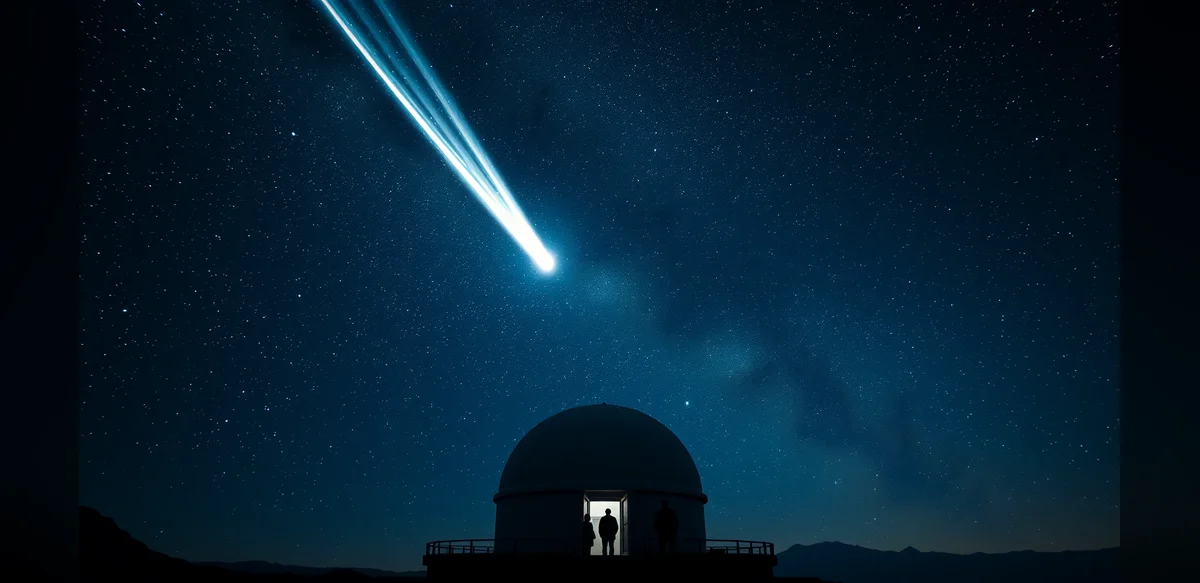
In July 2025 astronomers detected an unusual object racing through the solar system on a trajectory that indicated an origin outside our own. Named 3I/ATLAS, it became only the third confirmed interstellar visitor after 1I/Oumuamua in 2017 and 2I/Borisov in 2019. Although most evidence pointed to a natural comet, researchers with the Search for Extraterrestrial Intelligence quickly decided to check for artificial radio emissions.
3I/ATLAS displayed a visible coma and behaved like typical solar system comets, yet its high speed and path confirmed an extrasolar source. Such objects are rare because they travel rapidly and remain observable for only a short time. The first interstellar body sparked debate over possible non-natural explanations, while the second appeared clearly cometary. Every new case offers fresh data and an opportunity to test for technological signals.
SETI scientists used the Allen Telescope Array in Northern California to observe the object less than a day after its announcement. They monitored frequencies from 1 to 9 gigahertz for more than seven hours, targeting narrowband signals that natural processes do not generate. The array recorded nearly 74 million such signals, almost all produced by terrestrial technology including satellites and broadcast equipment. After filtering for direction, motion, and Doppler shift consistent with the comet itself, no artificial emissions remained.
The absence of signals supports a natural origin but also refines methods for identifying future anomalies. Researchers note that continued monitoring of every interstellar object helps establish baselines for what counts as unusual. The rapid response demonstrated the telescope array’s readiness for time-sensitive targets.

