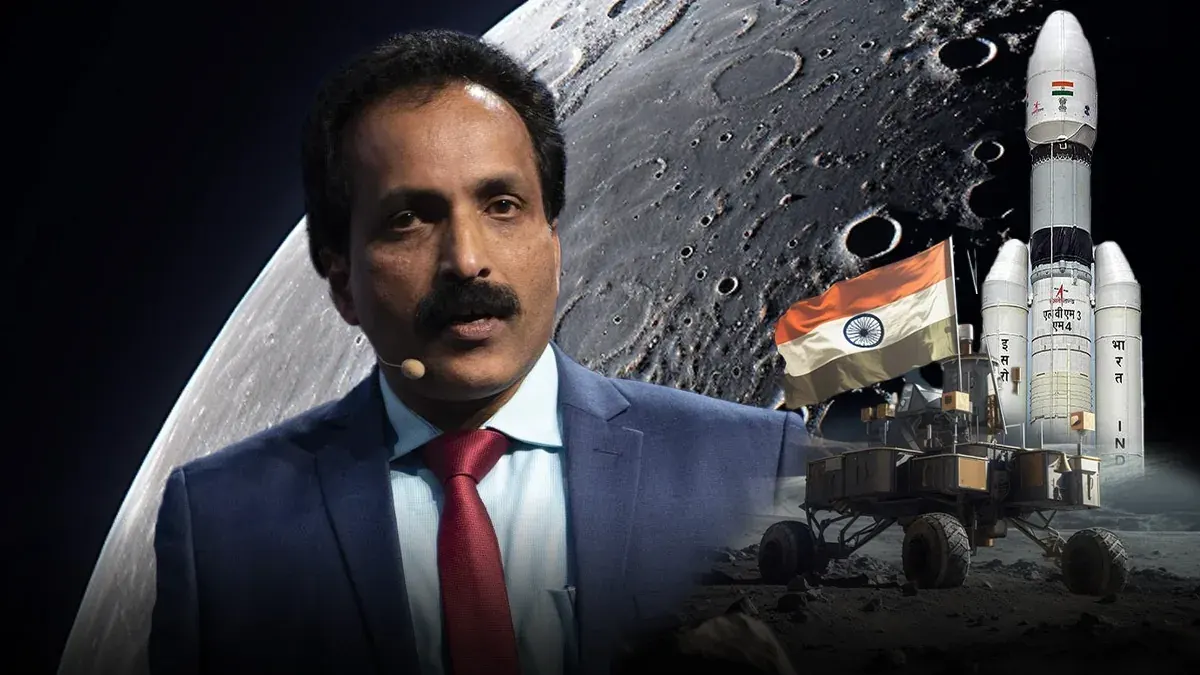
Chandrayaan-4, approved by the Union Cabinet and officially scheduled for launch in the
2027–2028 timeframe, marks India’s most ambitious lunar mission yet. Unlike Chandrayaan-3’s success of a soft landing, Chandrayaan-4 is a complex, multi-stage mission designed to collect lunar samples from the south polar region and return them to Earth.
While recent news suggests a 2027 or 2028 target rather than a strict 2026 August window, the technical differences from its predecessor are confirmed as revolutionary for India’s space program.
Here is everything that is different about Chandrayaan-4:
1. Primary Mission Objectives (Sample Return)
- Sample Collection: The main goal is to drill, collect, and bring back roughly 2–3 kg of lunar soil and rock samples from the Moon’s South Pole (specifically targeted at the Mons Mouton region) for scientific analysis on Earth.
- Significance: Successful completion will place India among an elite group (USA, Russia, China) capable of lunar sample return.
2. Complex Two-Phase Launch System
- Chandrayaan-3: Launched as a single stack using one launch vehicle.
- Chandrayaan-4: Due to weight and complexity, it will be launched in two separate launches.
- Phase 1: LVM3 will launch the Propulsion, Descender, and Ascender modules.
- Phase 2: PSLV or another LVM3 will launch the Transfer and Re-entry modules.
3. Five-Module Configuration
While Chandrayaan-3 consisted of three components (Propulsion, Lander, Rover), Chandrayaan-4 includes five specialized modules:
- Propulsion Module (PM): Powers transit to the Moon.
- Descender Module (DM): Lands the payload on the Moon.
- Ascender Module (AM): Lifts off from the Moon with samples.
- Transfer Module (TM): Manages docking in lunar orbit.
- Re-entry Module (RM): Safely returns samples to Earth.
4. Advanced Technical Requirements
- In-Orbit Docking: The mission requires two separate docking operations, which are new capabilities for ISRO.
- Heavier Rover: Chandrayaan-4 aims to land a significantly heavier ~350kg rover, compared to the ~30kg rover on Chandrayaan-3.
- Larger Exploration Area: The new rover will cover a larger area (1km x 1km) to collect diverse samples.
5. Finalized Landing Site: Mons Mouton
ISRO has selected the Mons Mouton region (near the South Pole) as the landing site. This site was chosen as the safest, flattest location (mean slope of ~5 degrees) based on high-resolution camera data from Chandrayaan-3.
All critical technologies for the ₹2,100+ crore mission are being indigenously developed, paving the way for India’s aim of a human lunar landing by 2040.