


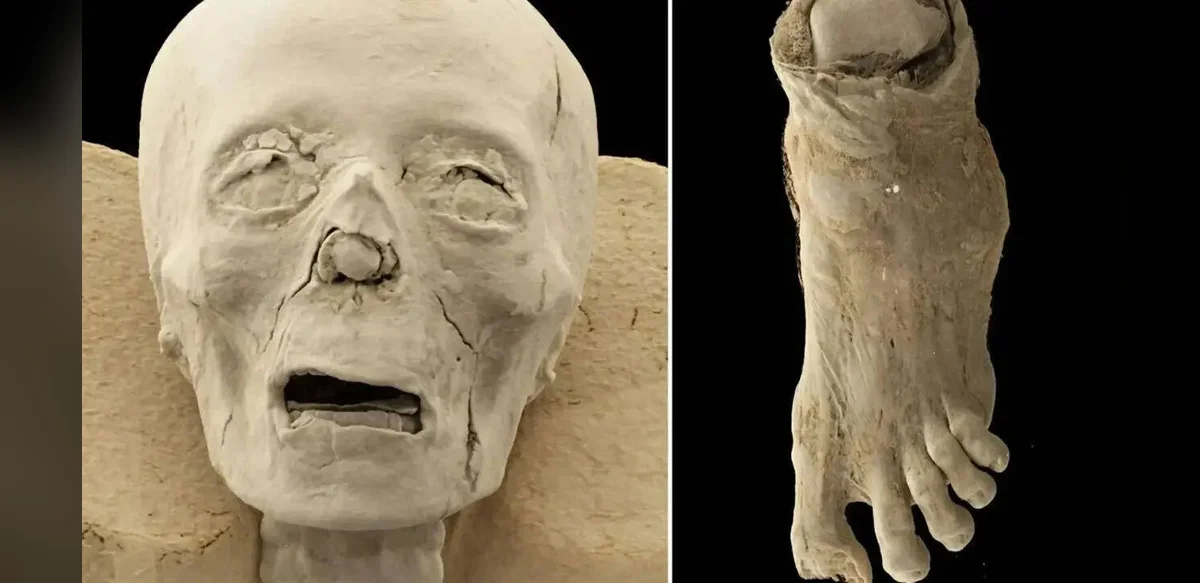
Advanced imaging techniques have provided new insights into mummified Egyptian remains dating back over 2,300 years. Researchers employed CT scans and 3D technology to examine preserved skulls, limbs, a hand, and a foot from the period between 401 and 259 BCE. These artifacts, stored in museum collections for many years, had not previously undergone such thorough analysis. The scans offer detailed views of internal bones, wrappings, and any deterioration without needing to unwrap or harm the items. Experts note that subtle elements, such as absent bone fragments and indicators of illness, are now detectable, shedding light on ancient embalming practices that remain partially mysterious.
The study included two skulls, two lower legs, a hand, and a solitary foot, all encased in fabric. High-definition scans produced clearer results than past efforts, uncovering details overlooked before.
A notable discovery involves the foot, which retains its original coverings. Imaging shows the internal bones clearly, including an apparent absence of part of the large toe. This could stem from injury before or after the mummification process, though the cause is not yet determined. Earlier assumptions that the foot belonged to a bird have been dismissed.
Some bones exhibit evidence of health issues. One leg shows characteristics of osteoporosis, a condition that reduces bone density and increases fracture risk. In antiquity, this might have led to significant movement difficulties or even deadly complications. Another leg appears to come from a younger person, with underdeveloped bones indicating a different age range, pending further examination.
The hand’s origins are less clear, with ongoing analysis to ascertain if it belonged to a child or an adult. Bone features and growth indicators are under review. Initial results suggest the parts originate from several people rather than one individual.
The research occurred at a facility associated with Semmelweis University, using CT imaging and 3D modeling to peer beneath the wrappings non-invasively. The visuals display dense layers of fabric around the bones.
The skulls maintain their overall form but show some distortion from age and compression. Outlines of facial bones and tooth placements are discernible in one specimen. Certain images reveal spaces within the wrapping layers, possibly deliberate aspects of the mummification ritual, though this is still debated.
Egyptian mummification involved intricate methods, including dehydration and careful bandaging with cloth, aimed at safeguarding the body for eternity. Some theories propose the use of substances to prevent decomposition, while others emphasize ceremonial elements. These recent scans raise additional inquiries, highlighting precise wrapping techniques but also differences among the specimens.

