


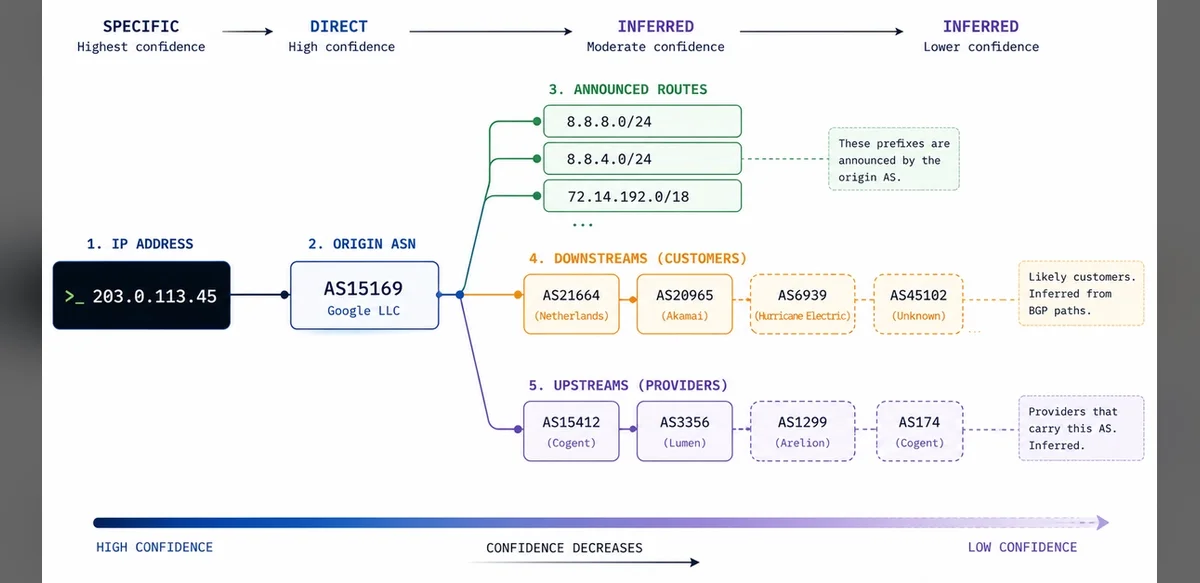
Investigators working with internet protocol addresses often turn to autonomous system number analysis as a foundational step. This approach allows mapping of relationships between different network operators without requiring extensive resources. An ASN represents a distinct routing domain on the internet, managed by a single entity that controls how traffic enters and exits its portion of the network.
The process begins by identifying the ASN associated with a target IP address. From there, analysts examine the routing announcements that define how that ASN connects to the broader internet. These announcements reveal upstream providers that carry traffic for the target network as well as downstream customers that rely on it for connectivity. Such relationships can indicate shared infrastructure or coordinated operations.
Routes play a central role because they show the paths data takes across multiple networks. By studying border gateway protocol updates, researchers can trace how an ASN advertises reachability to specific address blocks. Changes in these advertisements over time may signal shifts in business relationships or attempts to obscure origins.
Upstream connections typically involve larger transit providers that offer global reach. These links are critical because traffic from the target ASN must pass through them to reach most destinations. Identifying the main upstreams helps narrow the scope of further inquiries to a smaller set of organizations that handle the majority of the traffic.
Downstream relationships point to smaller networks or end customers that purchase service from the target ASN. These can include hosting providers, enterprise customers, or other operators. Mapping downstreams provides insight into the scale and nature of the network under examination.
Analysts combine this information with passive data sources such as route registries and historical BGP archives. The resulting picture offers context about the operational footprint of the networks involved. This method remains cost effective because it relies primarily on publicly available routing data rather than active probing.
Care must be taken when interpreting the results. Routing information can be influenced by commercial peering agreements, temporary reroutes during outages, or deliberate announcements designed to influence traffic flow. Over reliance on a single snapshot of data may lead to incomplete conclusions.
In practice, ASN analysis serves as an initial filter that guides subsequent steps. It helps prioritize which networks warrant deeper examination through other techniques. When combined with registration records and traffic analysis, the method contributes to a more comprehensive understanding of internet infrastructure.
The technique applies across various investigative contexts, from security research to regulatory compliance. Its value lies in the structured view it provides of how networks interconnect at the autonomous system level. Continued evolution of routing protocols and address allocation policies will likely influence how this approach develops in the future.
Professionals emphasize documenting each step of the analysis to maintain traceability. This includes recording the sources of routing data and the timestamps of observed announcements. Such records support verification and allow others to replicate the findings under similar conditions.
Overall, ASN pivots offer a practical entry point for understanding complex network topologies. They highlight the interconnected nature of internet service provision while underscoring the need for cautious interpretation of routing artifacts.

