


Accurately determining gravity’s strength has long posed significant challenges, with various studies yielding inconsistent results. However, a recent experiment offers hope for resolving these discrepancies and deepening our grasp of this mysterious fundamental force.
Researchers have conducted an advanced test to quantify the gravitational constant, known as big G. Past measurements have varied, suggesting potential flaws in experimental methods or gaps in our knowledge of gravity itself. This new study does not resolve the debate but demonstrates exceptional accuracy that could help unify future findings.
Gravity stands out as the weakest of the fundamental forces, complicating precise measurements. Unlike stronger forces like magnetism, which can be easily observed, gravity’s subtle effects between everyday objects are imperceptible. Additionally, experiments cannot be isolated from external gravitational influences, such as Earth’s pull.
In 1798, Henry Cavendish pioneered a solution using a torsion balance to measure gravity. This device involves a horizontal bar suspended by a thread, with masses at each end. Introducing another mass nearby causes a slight twist due to gravitational attraction, allowing calculation of the force while neutralizing Earth’s gravity.
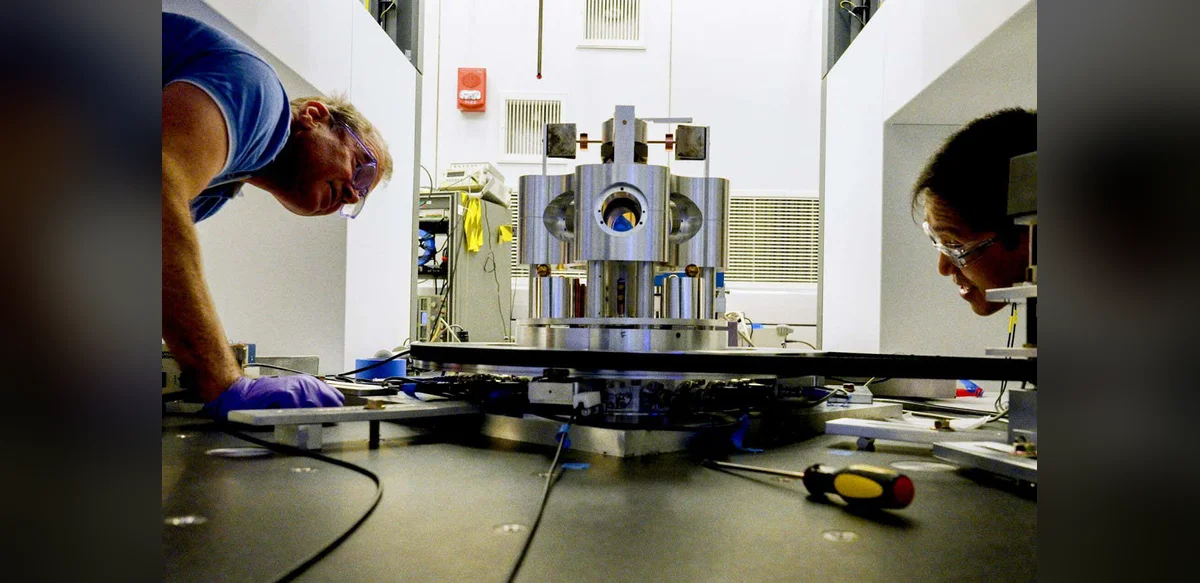
The current research, led by scientists at the US National Institute of Standards and Technology, refines this approach. It employs eight weights on two calibrated rotating platforms, all hung from thin ribbons. This setup replicates a 2007 French experiment but with meticulous attention to minimizing errors over a decade of work.
Experts praise the effort as exemplary experimental physics. The resulting value for big G is 6.67387×10⁻¹¹ cubic meters per kilogram per second squared, slightly lower than the prior measurement but aligning better with other historical data.
This constant serves not only as a gauge of gravity but also as a benchmark for measurement techniques across eras. By identifying and addressing previously overlooked uncertainties, the team has enhanced the reliability of such tests.
Their work sets the stage for even more accurate future studies, which are vital as astronomical observations—dependent on understanding gravity—improve. Discrepancies in big G could indicate anomalies with implications from laboratory scales to the cosmos.
While most scientists attribute remaining inconsistencies to unaccounted experimental biases, the possibility of unexpected gravitational behavior remains, potentially pointing to novel physics.

