


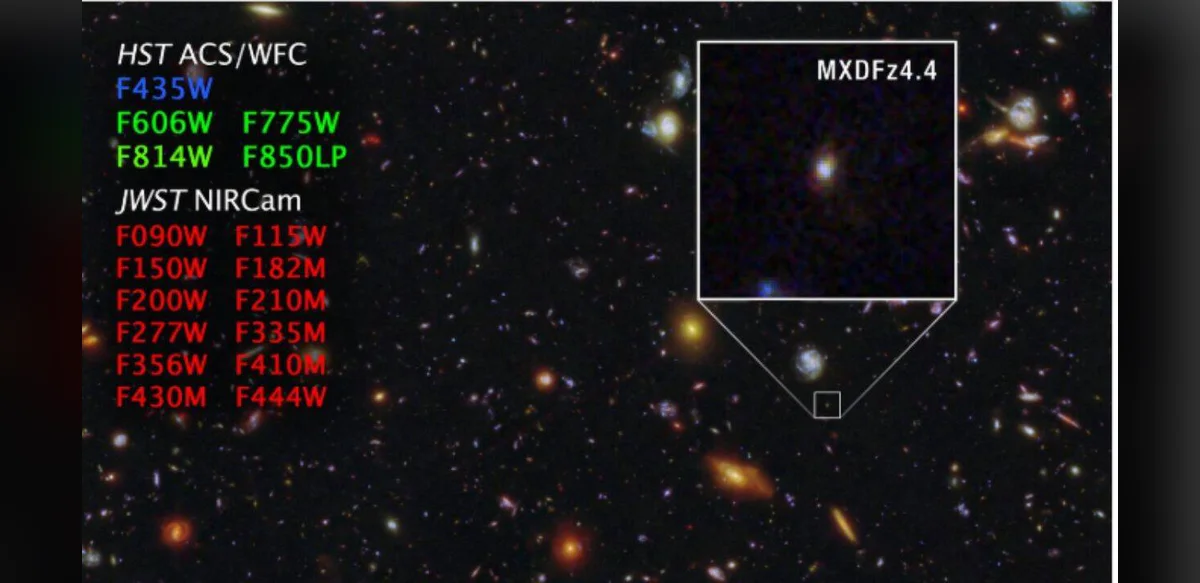
Astronomers have found ultraviolet light escaping from a small yet active galaxy that existed shortly after the universe began clearing its hydrogen fog. The find, based on Hubble Space Telescope observations and backed by James Webb Space Telescope and Chilean telescope data, offers a clearer look at a once-hidden era.
After the Big Bang, neutral hydrogen blocked much ultraviolet radiation from the first stars and galaxies. This fog lifted during the Epoch of Reionization. The galaxy MXDFz4.4 appears to have created paths for its light to pass through.
The object is about 100 times smaller than the Milky Way yet forms stars roughly ten times faster. Its intense activity likely opens channels in surrounding gas, letting ionizing radiation reach intergalactic space. The signal emerged during routine checks in October 2025 and required months of follow-up analysis.
No other galaxy from this period has shown such clear escaping light. Researchers suggest similar objects may exist in deep sky images and could have helped end the hydrogen fog, allowing light to travel freely across the cosmos.

