

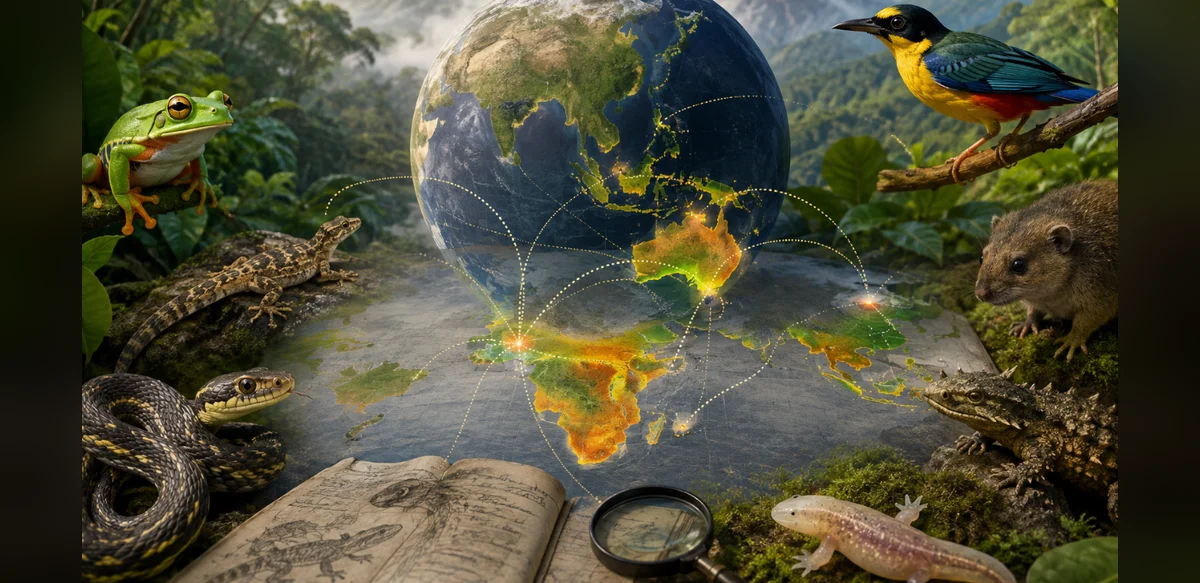
A comprehensive analysis spanning one hundred years reveals how progress in classifying species has significantly altered perceptions of where Earth’s richest areas for wildlife exist. Researchers examined shifts in documented distributions across major animal groups, finding notable revisions for certain categories while others stayed consistent.
Over the past century, improvements in identification methods and field studies have led to updated maps showing concentrations of life forms. These changes are most evident among reptiles and amphibians, whose recorded ranges have been revised substantially in many regions. In contrast, patterns for birds and mammals have shown little alteration despite ongoing discoveries.
The study highlights Australia and Southeast Asia as regions where updated information points to particularly high levels of variety for the affected groups. These areas now stand out more clearly as centers of ecological richness based on the refined data.
Additionally, the analysis indicates that the environmental elements tied to higher numbers of species have evolved in importance. Rainfall patterns now appear to play a stronger role in explaining where diversity peaks compared to earlier assessments.
This evolution in understanding stems from systematic efforts to catalog and verify species identities worldwide. Early 20th-century records often relied on limited observations, leading to incomplete pictures that later work has corrected through more extensive sampling and genetic insights.
For reptiles and amphibians, the revisions reflect both new findings in previously understudied zones and reclassifications that split or combined categories. Such adjustments have redrawn boundaries on global charts, emphasizing different locales than those prioritized before.
Bird and mammal records, however, benefited from earlier and more thorough documentation, resulting in stable representations that new information has not disrupted significantly. Their distributions continue to align closely with historical summaries.
The emergence of precipitation as a key driver underscores how climate variables influence habitat suitability. Areas with consistent moisture support greater variety, a factor that refined datasets now bring into sharper focus across multiple continents.
These findings carry implications for conservation planning, as updated maps can guide resource allocation toward zones with confirmed high value. They also illustrate the dynamic nature of scientific knowledge, where cumulative efforts gradually refine broad-scale pictures of natural systems.
Further examination of the data shows that tropical zones in the identified hotspots host complex ecosystems where small changes in classification ripple across larger patterns. This complexity arises from overlapping ranges and subtle differences among related forms.
Overall, the century of work demonstrates steady advancement in mapping life’s variety, with targeted impacts on certain animal classes and a growing appreciation for moisture-related influences on ecological abundance.


