


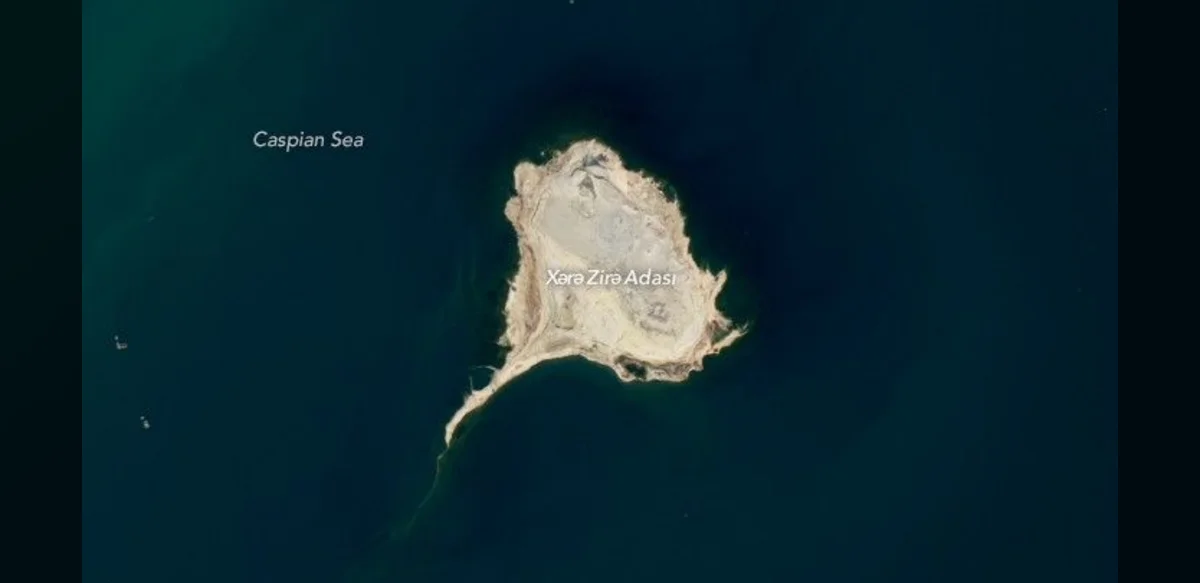
Azerbaijan’s mud volcano islands represent a distinctive geological feature along the Caspian Sea coastline. NASA’s Earth Observatory recently featured them in a blog post, noting their otherworldly appearance from orbit. These formations arise from explosive eruptions and wave erosion that sculpt the volcanic material.
Beyond their visual appeal, these islands offer valuable data for geologists on topics like hydrocarbon reserves, tectonic movements, and ecological dynamics. Azerbaijan, known as the ‘Land of Fire’ due to its natural gas vents, hosts at least 220 mud volcanoes, with estimates reaching up to 350.
Unlike typical volcanoes that release lava, mud volcanoes expel a mixture of mud, water, and methane gas from pressurized sedimentary layers rich in hydrocarbons. Over time, built-up pressure forces this material through cracks in the Earth’s surface.
Satellite images reveal the islands’ distinctive elongated forms with trailing extensions, similar to tadpoles. Geologist Mark Tingay explains that wave erosion creates these shapes, depositing mud in areas with reduced wave impact.
Many of these volcanoes are situated near the Absheron Peninsula and beneath the Caspian Sea, where over 140 have surfaced as islands. For instance, Khara Zira Island formed through eruptions, including major events in 1961 and 1995. Nearby islands have experienced dramatic outbursts that rapidly built new land, only for it to erode away over time.
NASA also documented a temporary ‘ghost’ island that appeared after a 2023 eruption in the Caspian Sea but vanished by 2024.
These islands hold scientific value due to their ties to subsurface oil and gas fields, aiding research on hydrocarbon formation and movement. However, they pose risks, as Tingay notes their potential for brief but intense eruptions that can produce massive fireballs from ignited gases.
Additionally, studying these mud volcanoes contributes to planetary science, as similar features may exist on other worlds, making Azerbaijan’s examples useful analogs for extraterrestrial environments.
In essence, Azerbaijan’s mud volcano islands highlight ongoing geological processes, originating from deep Earth activities and continuing to intrigue researchers.

