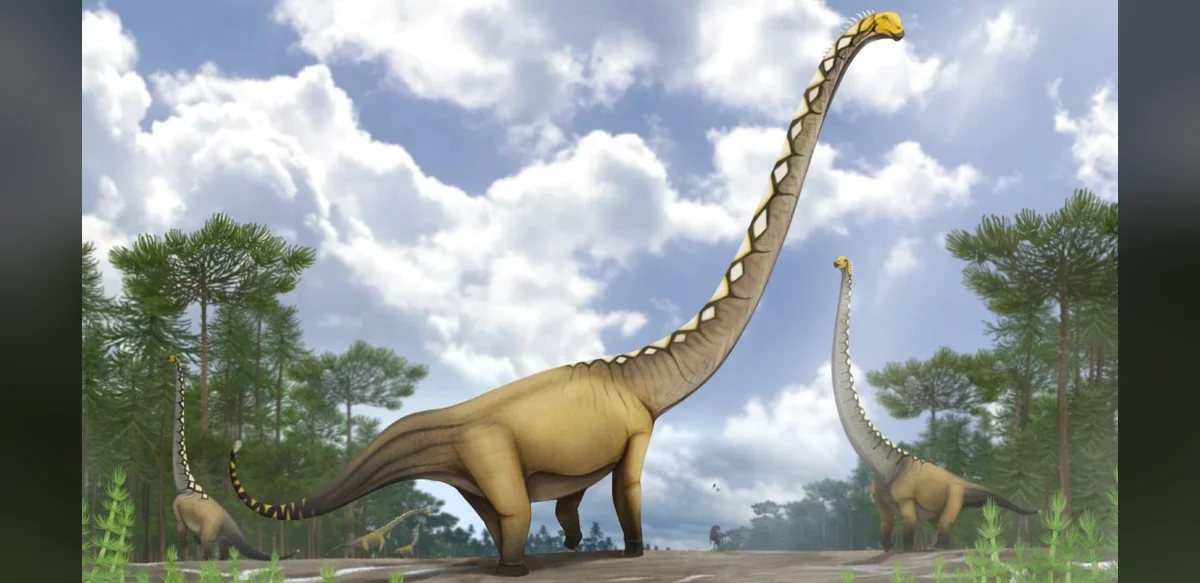
The common view of paleontology involves a researcher in shorts and hat dramatically revealing a complete skeleton from desert sands. In practice most ancient remains consist of isolated pieces such as a tooth or single bone fragment. Yet these scattered finds can reveal broader narratives. From one vertebra recovered in a Thai fossil site scientists have described a previously unknown species of giant dinosaur. Named Uragasaurus kalasinensis the animal was a long-necked sauropod similar to Diplodocus and Brontosaurus. It lived in Southeast Asian forests shortly before the Jurassic-Cretaceous boundary around 143 million years ago. The specimen represents the first formally named member of the Mamenchisauridae family from northeastern Thailand. The find broadens understanding of mamenchisaurid diversity in the region and adds details on their geographic range and evolutionary path according to a team led by paleontologist Apirut Nilpanapan of Mahasarakham University. The study appears in Scientific Reports. Removing a fossil from the ground often marks only the start of analysis. Researchers then undertake detailed comparative work that forms the core of the field. The vertebra came from the Phu Kradung Formation a deposit created over long periods by river systems that spread sediment across a wide floodplain. Because of deposition patterns the site has produced mostly fragments and few firm identifications. In this case the team recognized distinctive traits. Although one sauropod vertebra may appear similar to another to specialists features such as shape ridge patterns air-sac cavities and bone microstructure vary between species. CT scans and visual study showed a unique combination of these traits including specific air-pocket positions and a Y-shaped ridge pattern on the exterior. Nearby bones including a fibula and additional vertebrae were found but lacked enough diagnostic detail for assignment to the same species. Only the original vertebra supplied the anatomical markers needed to confirm a new taxon. The identification also indicates that mamenchisaurids lived in what is now Southeast Asia during the Late Jurassic expanding knowledge of the group beyond its primary Chinese record. A single vertebra buried in silt millions of years ago thus contributes to reconstructing how dinosaur lineages evolved and dispersed across ancient landscapes. Further finds from the formation and other Jurassic sites in Southeast Asia could yield additional insights into the early history and spread of these sauropods the authors note.