


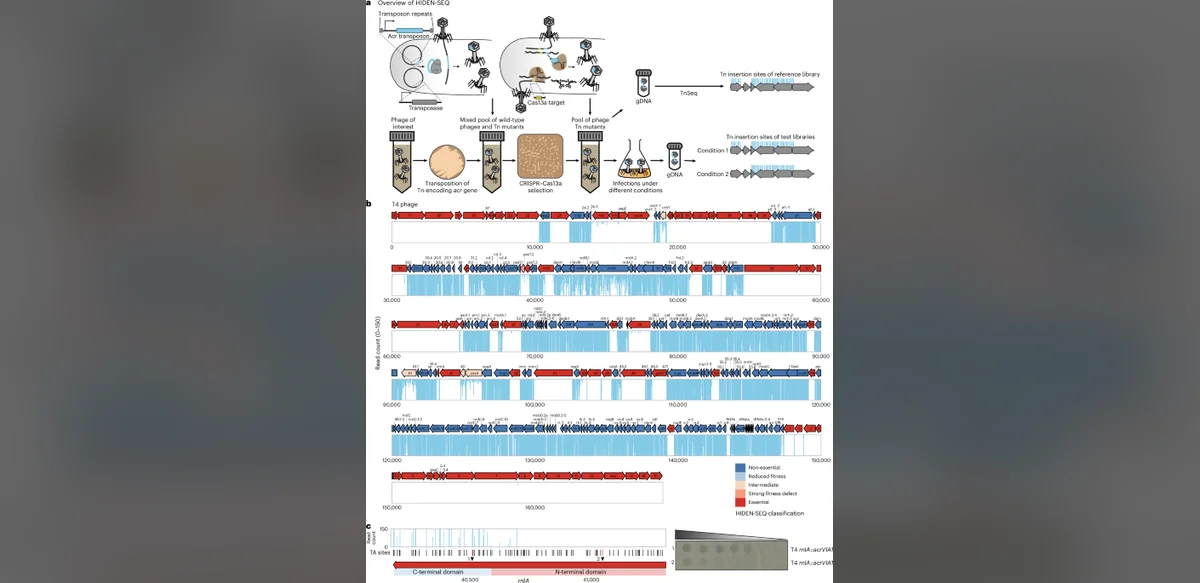
A new laboratory technique offers researchers an improved way to study the genetic requirements of bacteriophages. Called HIDEN-SEQ, the approach expands to hidden Acr-enabled transposon-insertion sequencing and functions as a specialized version of transposon-insertion sequencing designed for these viruses. Its core purpose is to connect individual phage genes with observable traits that researchers can select during laboratory work.
Bacteriophages are viruses that target bacteria and are common across many environments. Determining which of their genes are necessary for basic functions helps scientists understand how these viruses operate and interact with bacterial hosts. The HIDEN-SEQ method supports this goal by inserting mobile genetic elements into phage genomes in a controlled manner that reveals links between specific genes and measurable outcomes.
The technique builds on established sequencing practices but adds features that address challenges unique to working with phages. Through systematic gene disruption followed by selection for particular phenotypes, it becomes possible to identify essential genetic components more efficiently. This process generates data that can guide further experiments on viral biology.
Publication of the method appears in Nature Microbiology. The report describes how HIDEN-SEQ enables broader exploration of phage gene functions compared with earlier approaches. Scientists working in microbiology and related fields may find the tool useful for projects that require detailed genetic maps of these viruses.
Applications could include studies of phage behavior in different conditions and investigations into how genes contribute to infection cycles. By providing a direct connection between genotype and selectable phenotype, the method reduces some of the uncertainty that has limited previous mapping efforts.
Overall, HIDEN-SEQ represents a practical addition to the set of molecular tools available for phage research. Its design focuses on systematic coverage of the genome while maintaining compatibility with standard laboratory selection procedures. Continued use of the technique is expected to produce clearer pictures of gene essentiality across diverse phage types.
The development underscores ongoing interest in refining genetic analysis methods for small viral genomes. As more laboratories adopt HIDEN-SEQ, additional refinements may emerge that further improve its resolution and ease of use. The foundational description provided in the recent paper supplies the necessary starting point for such work.


