


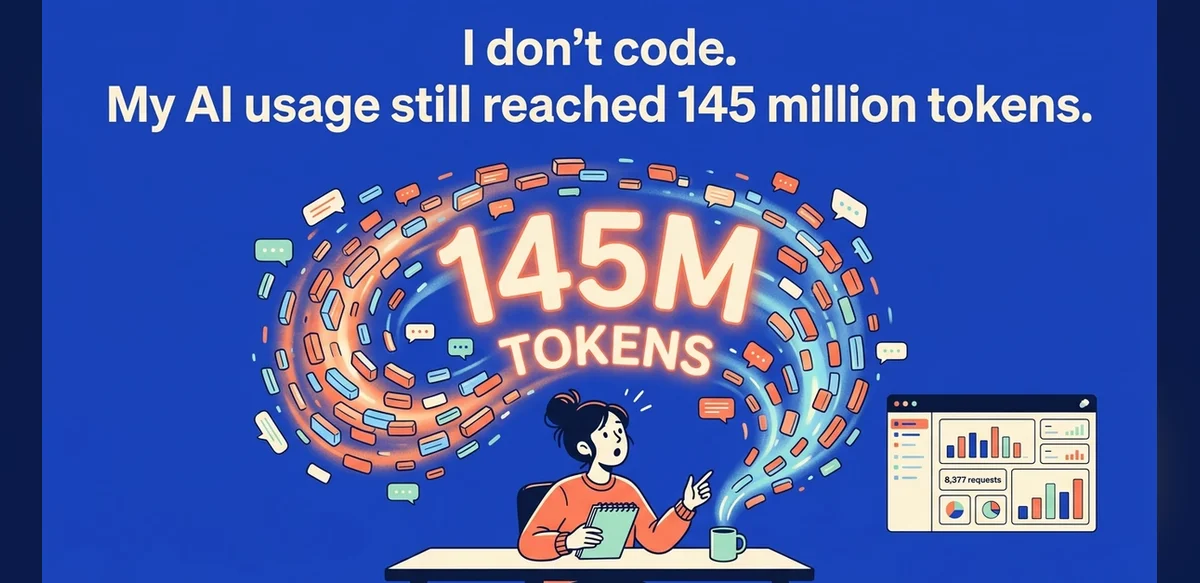
A person who does not write code has reported substantial engagement with artificial intelligence platforms, reaching a total of 145 million tokens according to usage records. The individual reviewed personal dashboard statistics and noted two primary figures that stood out during the review process. One figure indicated the overall token count while the second reflected an additional metric of 8,377. Tokens represent the basic units of text that AI systems process during interactions such as queries, responses and data analysis.
The reported usage occurred without any involvement in programming tasks. Instead the activity focused on everyday applications including document drafting, information summarization and general inquiry handling. This case illustrates how AI tools have become accessible beyond technical specialists. Many users now interact with these systems through standard interfaces that require no coding knowledge.
Token consumption accumulates quickly when conversations extend over multiple exchanges or when processing lengthy documents. Each input and output contributes to the running total. In this instance the aggregate reached 145 million tokens over an unspecified period. Such volumes suggest frequent or extended sessions rather than isolated queries.
Observers note that AI adoption continues to grow among diverse user groups. Non-technical individuals increasingly rely on these tools for productivity support in professional and personal contexts. The absence of coding requirements lowers barriers and allows broader participation. Dashboard metrics provide users with visibility into their own patterns of engagement.
The second recorded number of 8,377 likely corresponds to a count of sessions or similar discrete events though exact definitions vary by platform. Regardless of precise interpretation the combination of high token volume and session count points to consistent interaction. This pattern aligns with trends where AI serves as an assistive resource for writing, research and planning activities.
Further context on token economics shows that different models charge or track usage based on these units. Higher volumes can reflect complex tasks or iterative refinements during use. The individual in question maintained activity levels without shifting into software development roles. This separation highlights the tool-like nature of current AI offerings.
Industry analysts track aggregate usage statistics across populations but individual reports offer granular insight. The 145 million token milestone demonstrates that meaningful engagement does not necessitate technical expertise. Users from varied backgrounds can achieve comparable volumes through routine applications.
Questions remain about optimal usage strategies and long-term implications for work habits. Some individuals integrate AI into daily workflows while others employ it sporadically. The reported case falls into the former category given the scale of tokens processed. Continued monitoring of personal dashboards may reveal evolving patterns over time.
Overall the example underscores expanding reach of AI technologies. Accessibility features enable participation from those outside traditional technical fields. As platforms refine their interfaces further growth in non-coder usage appears probable. The specific figures of 145 million tokens and 8,377 provide a concrete illustration of one such trajectory.


