


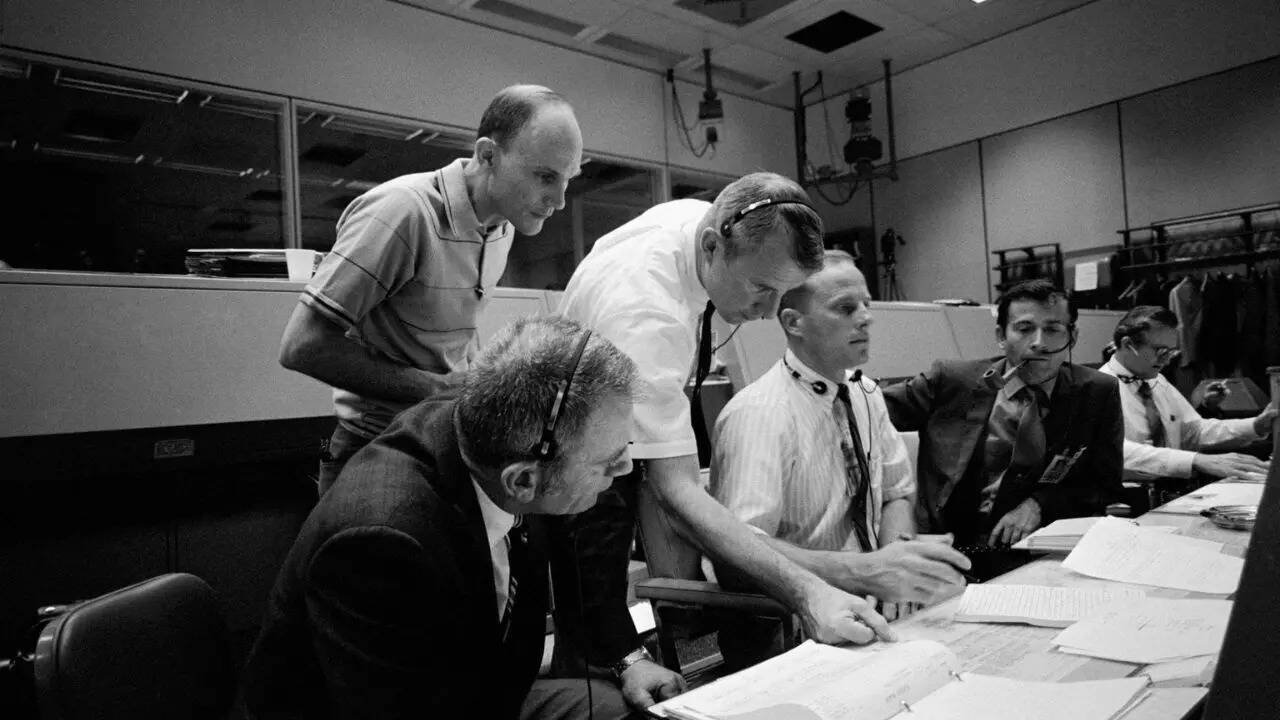
NASA experts monitored the trajectory of Apollo 13 (Image courtesy of NASA).
Reflections on Apollo 13
The takeoff and initial phase
The emergency: ‘Houston, we’ve had a problem’
View footage of Apollo 13: ‘Houston, We’ve Had a Problem’
Resourcefulness and endurance
Circling the moon and the extended return trip
The team of Apollo 13: Orbital champions
James A. Lovell Jr.: The steady leader
John ‘Jack’ Swigert: The versatile operator
Fred W. Haise: The engineering foundation
Side-by-side review: Apollo 13 and Artemis II
Notable contrasts include:
Farthest distance: At 1:56 p.m. EDT on Monday, Artemis II surpassed Apollo 13’s mark of 248,655 miles (400,000 km) from Earth.
Objectives: Apollo 13 intended to touch down on the moon but canceled the plan. Artemis II involves a scheduled test orbit around the moon, using a slingshot path for safe return.
Team composition: Artemis II represents contemporary diversity, featuring a female astronaut, a person of color, and a Canadian in its four-member crew. Apollo 13 consisted of three male U.S. astronauts.
Vehicles and advancements: Apollo 13’s Odyssey and Aquarius modules demanded on-the-spot solutions during the crisis. Artemis II’s Orion capsule includes enhanced environmental controls, space for four crew members, and integrated backup safety features.
Path and precautions: Each mission employs a free-return route to circle the moon and head back securely, though Apollo 13 adopted it as an emergency measure, while Artemis II designed it into the original strategy.
Reentry method: Both end with parachute-assisted ocean landings, highlighting the reliability of established recovery techniques.
Insights from Apollo 13
For the first time in over five decades, people are heading back toward the moon. NASA’s Artemis initiative dispatched four astronauts in the Orion vehicle for an almost 10-day operation. The endeavor merged research, equipment evaluation, and human perseverance, echoing the innovative drive that propelled Apollo teams into orbit more than 50 years ago. As the venture concludes with an accurate descent into the Pacific, a subtle feeling of historical continuity emerges. Fresh launch vehicles, new explorers, and bold goals are emerging, yet the future rests on experiences gained from one of history’s most renowned space efforts: Apollo 13. Launched on April 11, 1970, Apollo 13 was set to be America’s third moon landing. Instead, it turned into a desperate effort to stay alive following an oxygen tank rupture in the service section. The spacecraft departed via a Saturn V from Florida’s Kennedy Space Center, achieving Earth orbit without issues before starting its path to the moon. Fifty-six hours in, Commander James A. Lovell, Lunar Module Pilot Fred W. Haise, and Command Module Pilot John L. Swigert experienced a sharp explosion. Oxygen supplies diminished, electricity waned, and the intended moon visit shifted to a battle for life. Apollo 13 was meticulously organized. The astronauts were seasoned, and the vessel— including the command module ‘Odyssey,’ service module, and lunar module ‘Aquarius’— represented cutting-edge technology. Every detail had been verified repeatedly. But suddenly, everything altered. The rocket ascended with immense power, surrounded by fire and exhaust at the site. Once in orbit, the team conducted verifications, readying for the burn to propel them moonward. Over the first 48 hours, operations seemed standard, mirroring prior Apollo flights. Ground control oversaw all data, confirming optimal function. On April 13 evening, the normalcy ended. Swigert activated a control to mix the oxygen reserves in the service area, triggering a loud blast through the ship. Oxygen readings fell, systems lost power, and warnings activated in the main cabin. ‘Houston, we’ve had a problem here,’ Swigert communicated. The lunar landing goal vanished; now, staying alive was paramount. Commander Jim Lovell observed vapor escaping into the void and quickly grasped the gravity of the situation.

