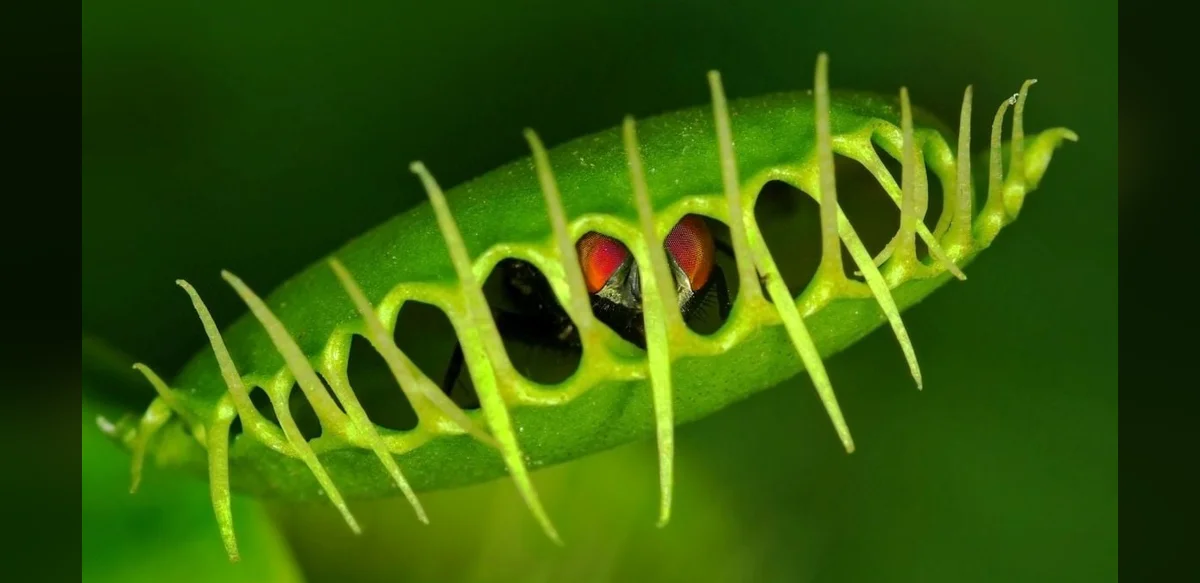
Predators must often outpace their targets to capture food. Plants rarely move quickly. Yet the Venus flytrap has developed a swift tactic to capture insects and spiders that might otherwise escape. The plant attracts prey into its leaf trap, which then closes tightly to hold the victim for digestion. Scientists have long sought to explain how the plant achieves such rapid motion. A research group headed by physicist Jeongeun Ryu at the French National Center of Scientific Research has now pinpointed the cause. The plant quickly reduces rigidity in the outer cell walls of the trap. This allows the outer layer to stretch more than the inner one, curving the leaf past a threshold until it snaps closed. The team describes this as the quickest known adjustment of wall properties in plants. Their work points to a form of plant motion that relies on changing material traits, offering ideas for motion systems without muscles. Some plants perform controlled movements. The sensitive plant folds its leaflets when touched, possibly to avoid harm. Such actions often depend on fluid shifts that alter internal pressure and shape. Earlier models suggested the flytrap used similar fluid dynamics, with water shifting between leaf sides to create uneven expansion. However, two issues undermine that view. Water travels slowly in plant tissue, requiring 30 to 150 seconds to cross the trap thickness, far longer than the roughly one-second closure time observed. No spreading wave of motion appeared either, which fluid flow would produce. The process instead involves two stages: gradual inward bending to a critical point, followed by the 0.2-second snap. Tests with cut strips and clamped traps showed slow bending before the fast phase. Measurements revealed that outer cell walls lost about 40 percent of their stiffness while inner walls stayed unchanged. Before activation, internal cell pressure is balanced. When prey touches trigger hairs twice, the outer wall softens, enabling faster expansion on that side and causing the leaf to bend and close.