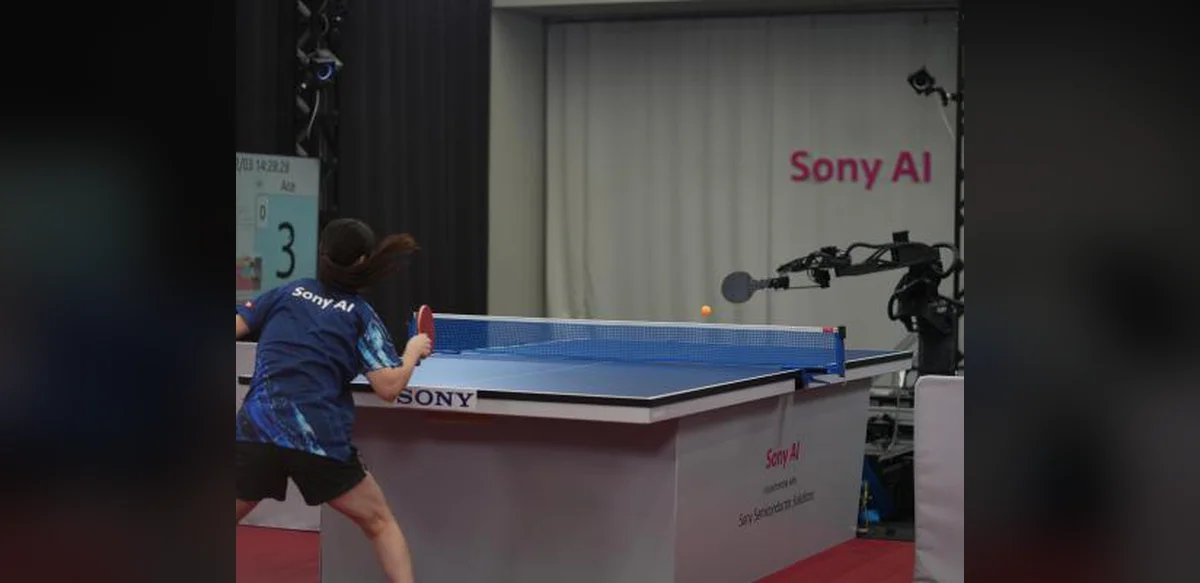
A robot equipped with artificial intelligence has triumphed over skilled table tennis players, marking a key advancement in machines competing against humans in physical sports. The system, called Ace and created by Sony AI, secured victories in three of five games against high-level players but fell short in the two matches against professionals, managing to win just one game across seven total. Experts view this accomplishment as a major step forward in robotics, where table tennis—with its need for rapid responses, sharp observation, and precise abilities—has long served as a demanding benchmark for technological progress. During the contests, conducted under standard rules, Ace demonstrated expertise in managing spin, coping with challenging plays like balls grazing the net, and executing a swift backspin stroke that a pro deemed unattainable. A study detailing the robot appeared in Nature on Wednesday, though project researchers noted further enhancements since the paper’s submission. ‘We challenged increasingly skilled opponents and defeated progressively tougher ones,’ stated Peter Dürr, head of Sony AI in Zurich and the initiative’s leader. AI specialists often employ games such as chess, Go, poker, and Breakout to train systems in handling intricate choices. Developing a smart robot elevates this by demanding effective physical implementation of those decisions. Ace avoids certain table tennis complexities with its eight-jointed arm mounted on a rolling platform, rather than requiring bipedal movement. It relies on several cameras positioned around the court to monitor the ball’s location and rotation, instead of binocular vision. By focusing on the ball’s markings, the setup calculates spin and rotation axis in the brief time before the ball arrives. Strategies for countering spin and selecting shots were refined through 3,000 hours of simulated matches. Other techniques, like serving, were adapted from those of expert athletes. Ace did not begin as a master; initially, it struggled with slow, low-spin balls, responding feebly and inviting strong counters. However, it excelled at handling irregular situations, such as net-clipped balls, reacting swiftly to changed paths. ‘When I served with intricate spin, Ace countered with similar complexity, complicating my response,’ said Rui Takenaka, a top player. ‘But with a basic serve—known as a knuckle serve—Ace’s return was straightforward, allowing me an easier attack on the next shot, which I believe helped me win.’ In one instance, Ace performed an unexpected early interception with backspin, prompting former Olympic competitor Kinjiro Nakamura to admit that while he initially thought it impossible, people might now adopt the technique. Competing against Ace poses unique challenges, as it lacks eyes for opponents to gauge, shows no physical cues, and remains unaffected by tension in close scores like 10-10. Dürr explained: ‘Players seek to read their rival’s eyes. Ace’s ‘eyes’ are cameras scattered across the court, revealing no plans or emotions.’ Jan Peters, a professor of intelligent autonomous systems at Germany’s Technical University of Darmstadt who has researched similar robots, described the work as ‘remarkably impressive’ but noted that table tennis studies won’t address all core robotics issues, like object handling. ‘For broad public utility, substantial traditional engineering remains essential,’ Peters said. ‘A transformative moment akin to ChatGPT’s impact in 2022 could arrive in the coming decade, possibly sooner rather than later.’