


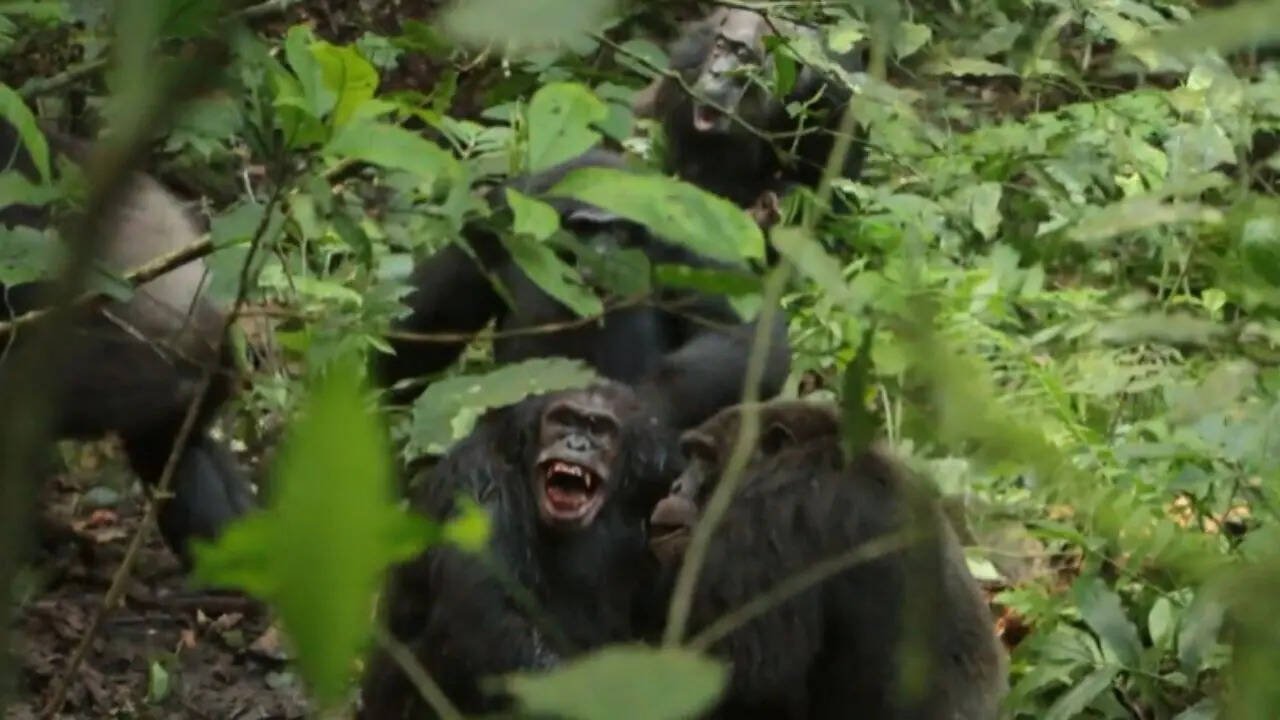
A community of around 200 wild chimpanzees in Uganda’s Kibale National Park, once united, has split into two rival groups involved in lethal confrontations over the past eight years, according to a study published in the journal Science. Researchers, who have monitored the Ngogo chimpanzees for three decades, describe this division as an uncommon occurrence, estimating that such splits happen roughly every 500 years in chimpanzee populations.
The lead researcher, Aaron Sandel, an anthropologist at the University of Texas and co-director of the Ngogo Chimpanzee Project, noted that chimpanzees typically exhibit territorial behavior and aggression toward outsiders. However, this group had previously coexisted peacefully, engaging in grooming, food sharing, and coordinated movements.
The chimpanzees have now separated into Western and Central factions. Sandel first observed signs of division in 2015, when members of the Western group fled from pursuing Central individuals. Following this, the groups avoided each other for about six weeks, and subsequent encounters became increasingly hostile.
By 2018, the split was complete, with the smaller but more aggressive Western group launching attacks on the Central chimpanzees. Since then, at least 24 assaults have resulted in the deaths of seven adult males and 17 infants, though researchers suspect the true toll is higher.
One notable incident involved the killing of a 36-year-old chimpanzee named Basie. He was ambushed by a Western patrol of about 13 adults while foraging. The attackers surrounded and assaulted him, leading Sandel to compare his role to that of a war reporter documenting the event.
Basie’s death, the second in the conflict, prompted questions about how a tightly bonded group could turn to such violence. The study identifies potential causes, including the large group size, competition for resources, and rivalry among males for mating opportunities.
Three key events appear to have accelerated the rift. In 2014, the deaths of five adult males and one adult female disrupted social connections. In 2015, a new dominant male named Jackson overthrew the existing leader, coinciding with initial separations. Finally, a 2017 respiratory outbreak killed 25 chimpanzees, including a male who helped maintain links between subgroups, just before the full division in 2018.
This is not the first recorded chimpanzee conflict. In the 1970s, primatologist Jane Goodall observed a four-year war following a split in a group at Tanzania’s Gombe Stream National Park, which she described as a profoundly disturbing period.
Similar patterns emerged in both cases, such as leadership changes, deaths of key social figures, and disease outbreaks preceding the violence. Co-author Jacob Negrey, a primatologist at the University of Arizona, explained that reduced interactions can erode group identity, leading to rapid escalation of aggression.
The conflict continues, and as chimpanzees are among humans’ nearest relatives, the study suggests possible parallels with the origins of human warfare.

