


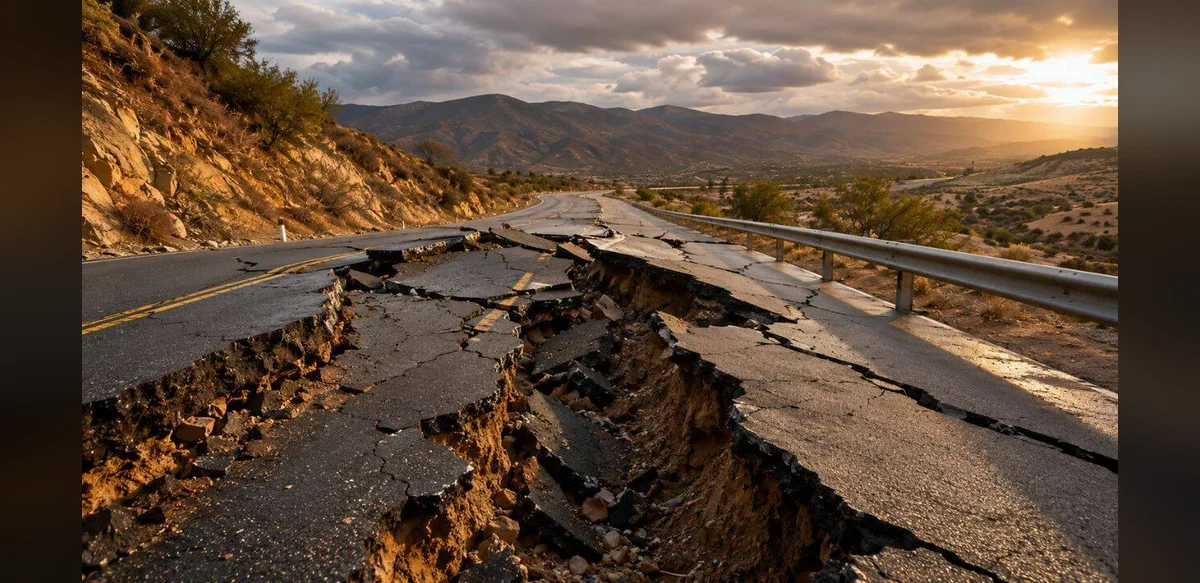
For decades, discussion about California’s next major earthquake has focused mainly on one fault. The southern section of the San Andreas has been seen as the state’s primary concern because it has stayed quiet since the mid-1800s even as movement continues below ground. That long quiet period has suggested energy is building up, though how it might release has been unclear.
New research takes a broader view by studying how two nearby fault systems interact. The results indicate that underground strain in parts of Southern California has reached levels matching or exceeding those seen in the past thousand years. The work does not suggest an earthquake is about to happen, but it shows several large faults may now be more connected than thought.
The study, led by Dr Liliane Burkhard at the University of Bern and published in Advancing Earth and Space Sciences, examined stress buildup on the southern San Andreas Fault and the nearby San Jacinto Fault. Though each has caused major quakes on its own, they lie close enough that activity on one might affect the other.
Instead of looking only at past quakes, researchers modeled how tectonic stress has grown over centuries. Their simulations combined evidence from ancient earthquakes with modern data to track how strain has moved between the faults.
The findings challenge the idea of a single fault nearing failure on its own. They show that interaction between neighboring faults matters greatly.
Focus fell on Cajon Pass, northeast of Los Angeles, where the two faults come close before diverging. Such spots can act as gateways that shape how a rupture spreads. Records show both stopping and crossing have happened at different times.
Faults do not move smoothly. As plates shift, rock sections lock, building pressure until it releases in an earthquake. To place current conditions in context, the team reconstructed roughly a thousand years of seismic history using carbon dating, tree rings, and geological traces.
The models showed stress has built across both faults in similar patterns. Notably, stored strain now appears unusually high on both at once. One section of the San Jacinto Fault exceeds any level in the thousand-year record, while nearby parts of the southern San Andreas are near those peaks.
Researchers say this may raise the chance that movement on one fault could extend to the other during a large quake.

