


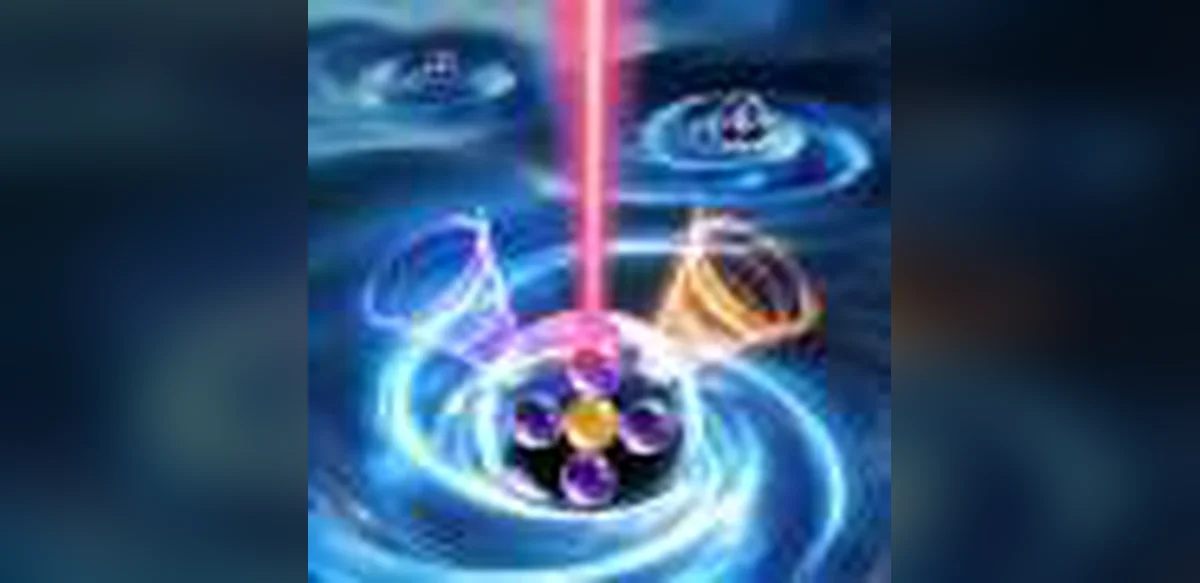
Electrons can move collectively to form quasiparticles under specific conditions. One example is the quantum Hall effect, which appears when electrons are restricted to an extremely thin layer, cooled near absolute zero, and placed in a powerful magnetic field.
Parton theory proposed that emergent partons, quark-like quasiparticles in condensed matter, explain these collective behaviors in quantum Hall states. Geometric models further indicate that small changes in the quantum metric can create spin-2 excitations known as chiral gravitons.
In 2024, scientists at Nanjing University and partner institutions aimed to find experimental proof of these chiral gravitons, which had been hard to detect. Their findings, published in Nature Physics, describe multiple chiral gravitons: one at low energy and another at high energy. The work suggests a new method to examine partons within fractionalized quantum systems.
Senior author Lingjie Du noted that around half filling in fractional quantum Hall states, only the low-energy graviton mode appeared. Near quarter filling, such as at filling factors 2/7 and 2/9, both low- and high-energy modes were seen. Earlier data showed graviton energy scales with the fractional charge of the state. Two modes in one state therefore imply two distinct fractional charges, consistent with parton theory.
Prior experiments had identified only the low-energy graviton. High-energy partons require greater excitation energy to observe. Detecting them would strengthen support for parton theory of the fractional quantum Hall effect.
Du clarified that the partons in question are fractionally charged quasiparticles distinct from anyons. Quantum metric fluctuations can produce long-wavelength spin-2 excitations tied to high-energy partons. The team applied circularly polarized resonant inelastic light scattering at roughly 50 millikelvin and magnetic fields up to 14 tesla to measure the spin and energy of the high-energy graviton mode.
They examined two-dimensional electron gases in single quantum wells where the fractional quantum Hall effect occurs. The technique revealed both low- and high-energy gravitons, supplying spectroscopic evidence for previously unseen high-energy partons. The results indicate these partons possess genuine geometric dynamics rather than existing only as theoretical ideas.
Du stated that observing multiple gravitons, especially the high-energy mode, validates the geometric theory of the fractional quantum Hall effect and supplies direct evidence that fractional quantum Hall partons are real quasiparticles in strongly correlated matter.

