


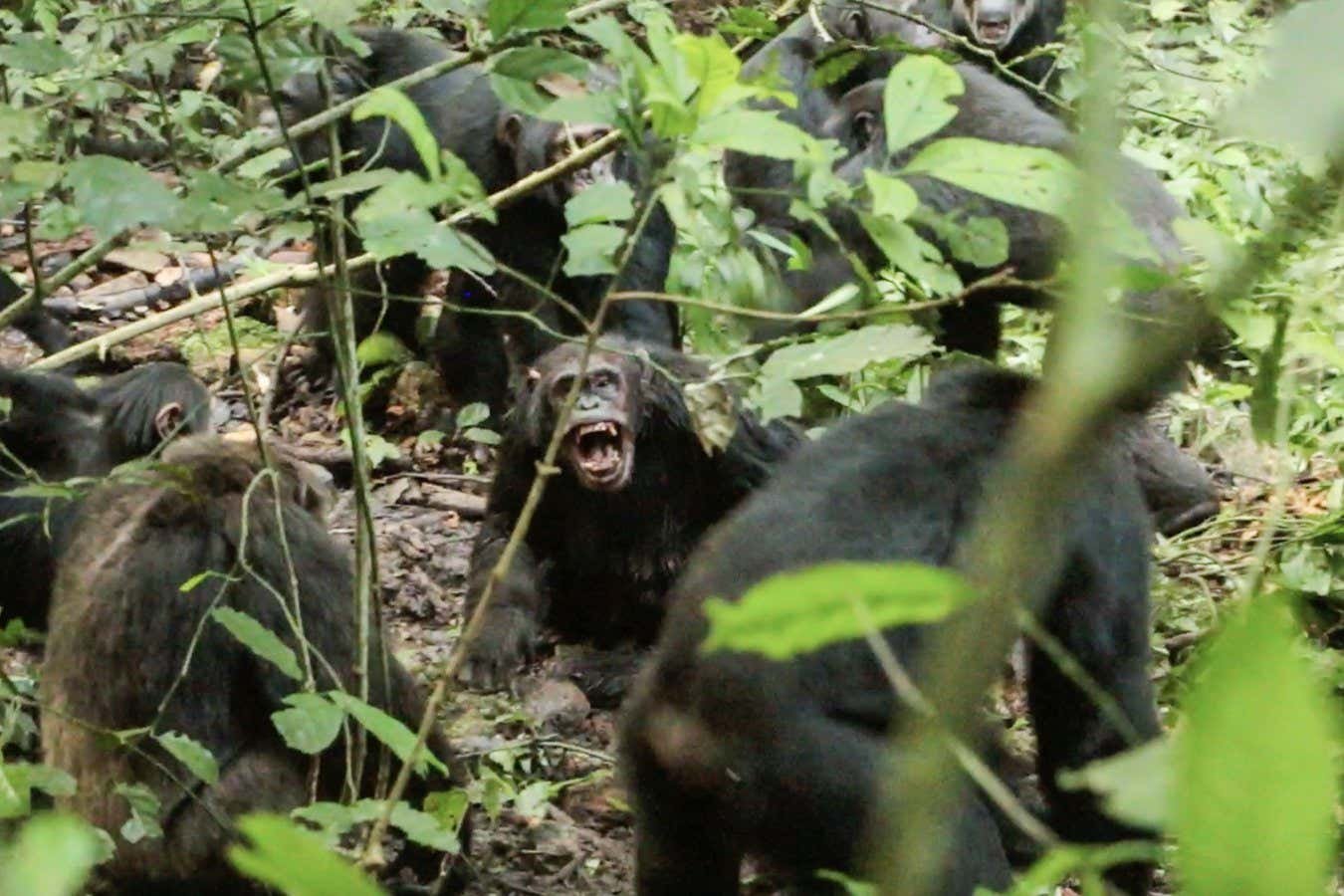
Experts examining a deadly clash within a formerly united chimpanzee community argue that it mirrors aspects of human civil conflicts.
A previously cohesive chimpanzee population in Uganda’s Kibale National Park has divided into two opposing factions, resulting in ongoing hostility and fatalities. Researchers believe this division implies that human warfare has profound evolutionary foundations, not just arising from advanced civilizations.
Aaron Sandel from the University of Texas at Austin, along with his team, reviewed 24 years of social interactions, a decade of GPS tracking data, and three decades of population statistics for these chimpanzees (Pan troglodytes).
Sandel emphasizes caution in terminology, noting that while the events resemble human warfare, they are not identical. Key similarities include evolving group loyalties driving fatal confrontations.
Chimpanzees are notorious for aggressive acts against one another, usually targeting outsiders or offspring from competing males.
The Ngogo community, numbering between 150 and 200 individuals, was one of the largest documented chimpanzee groups. These primates, together with bonobos (Pan paniscus), are humanity’s nearest kin.
From 1995 to 2015, the group functioned as a unified entity with flexible social structures, where members formed short-term subgroups during the day but shared territory and reunited at night.
Female chimpanzees typically leave their birth group upon reaching maturity, whereas males stay lifelong. Before 2015, Ngogo’s adult males grouped with females, collaborated on hunts, and jointly defended borders.
On June 24, 2015, a pivotal meeting occurred in the heart of their range. One subgroup, called the central faction, drove off another, termed the western faction.
Unity eroded from that point; by 2018, the split was irreversible. From 2018 to 2025, the western faction launched 24 assaults, causing the deaths of at least seven adult males and 17 young in the opposing side.
Sandel notes uncertainty about which side started the feud, despite the central group’s initial pursuit. Both participated in boundary disputes as divisions solidified, but the western group emerged as the primary attackers, accountable for all deadly incidents.
The team identifies multiple triggers for the collapse, including competition for nourishment, the loss of five key males and one female in 2014 that strained relationships, a shift in leadership among dominant males, and a disease outbreak.
This epidemic in January 2017 claimed 25 lives, including the final two males linking both factions, extinguishing any chance for reunification.
The researchers propose that this sequence of events sheds light on the evolutionary basis of human disputes. Modern human conflicts are often linked to cultural divides like ethnicity, faith, or ideology, but this overlooks fundamental social mechanisms seen in our primate relatives.
The study suggests that everyday gestures of forgiveness and bonding between individuals could foster peace.
Maud Mouginot from Boston University describes two main theories on warfare’s origins: one views it as a modern cultural product tied to farming and states, while the other traces it to ancient evolutionary traits. She believes the Ngogo findings bolster the latter perspective.
This research shows that group separation and ensuing violence can occur without the cultural elements commonly associated with human wars.

