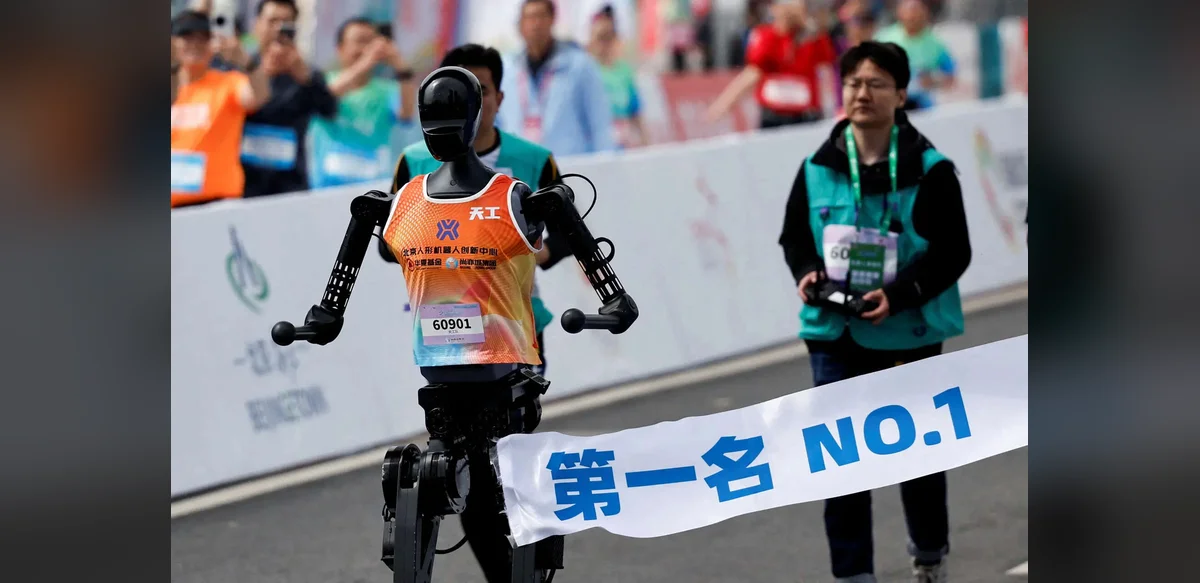
Over 300 humanoid robots will compete in China’s second robot half-marathon on Sunday, tackling more challenging landscapes to demonstrate advancements in their design. This event supports Beijing’s goal of establishing the robotics sector as a key economic driver. More than 70 teams, a sharp increase from last year, will participate in the 21-kilometer race in Beijing, featuring sloped roads and park areas. Georg Stieler, Asia managing director at a technology consulting firm, noted that the competition will reveal improvements in part durability and battery performance. He emphasized the need for robot manufacturers to balance evolving product quality with cost constraints. Unlike last year, when all robots were operated remotely, nearly 40% of this year’s entrants will move independently, showcasing the sector’s progress. However, the race may also expose difficulties in replicating human-like motion and efficiency. In the previous event, some robots stumbled shortly after starting, and the victorious Tiangong Ultra, created by a state-supported Beijing robotics center with UBTech, completed the course in 2 hours and 40 minutes—far slower than the human champion. This year, Tiangong Ultra will operate entirely on its own, using sensors to dodge barriers and imitating human strides via extensive data-based training, according to the robotics center. The center explained that achieving speeds near those of elite human runners requires rapid sensing, decision-making, and high computational demands. Online videos from this month’s nighttime training sessions in Beijing depicted some robots smoothly mimicking running at up to 14 kilometers per hour, while others moved awkwardly, toppled, or collided with obstacles, indicating potential difficulties in finishing. China leads in global humanoid robot deployments, representing over 80% of the 16,000 units installed worldwide in 2025, per a research firm’s data. The leading U.S. company, Tesla, held just 5%. Local frontrunners AgiBot and Unitree each delivered over 5,000 units last year, the most anywhere, with Unitree planning to scale up to 75,000 units per year. Although the half-marathon offers engaging spectacles, specialists argue that the abilities shown do not yet support broad commercial use in industries, where fine motor skills, environmental awareness, and complex task handling are essential. Unitree’s models are mainly employed in research, entertainment shows, and customer service roles, as stated in its public filing. Experts indicate that widespread adoption in homes or factories remains distant, even in China. At a recent Beijing technology conference, the founder of an embodied intelligence startup remarked that low robot intelligence and unreliable performance hinder applications, describing the field as nascent with much activity resembling showmanship rather than practical work. The Chinese authorities have prioritized embodied intelligence, or physical AI, to enhance productivity and modernize manufacturing through automation. Yet, domestic companies face hurdles in creating AI software to rival human worker efficiency, while parts suppliers deal with pricing issues, according to analysts. To advance software, firms are investing in gathering real-world data via sensor-equipped humans and increasing robot placements in production environments. In 2024, UBTech deployed fewer than 10 humanoids in factories, rising to over 1,000 last year. This year, the company plans to release 10,000 full-sized models, including versions for diverse business applications, as shared by its chief business officer during a media visit to its southern China facility. He highlighted that AI development depends on collecting substantial high-quality data.