


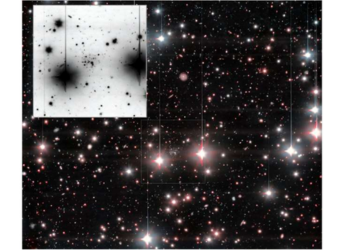
Researchers have identified a new ultra-faint dwarf galaxy orbiting the Andromeda galaxy, named Andromeda XXXVI. An amateur astronomer first noticed it in archived images from the Pan-Andromeda Archaeological Survey, with confirmation coming from detailed observations using the 10.4-meter Gran Telescopio Canarias. Located approximately 2.5 million light-years from Earth, this galaxy is exceptionally dim, with an absolute magnitude of about -6, and spans roughly 200 light-years in diameter. It contains a small number of stars but appears to have a substantial dark matter content, positioning it as a potential remnant from the universe’s initial phases.
Details of the Find and Features of Andromeda XXXVI
As detailed in a recent study, Giuseppe Donatiello initially detected Andromeda XXXVI in PAndAS data, followed by verification through in-depth imaging with the OSIRIS instrument on the GTC. Analysis of its color-magnitude diagram indicates an ancient stellar population, around 12.5 billion years old, with low metallicity levels ([Fe/H] ≈ –2.5). The galaxy is situated about 2.53 million light-years from our planet, or 388,000 light-years from the Andromeda galaxy (M31). Its faint brightness (M_V ≈ –6.0) and compact size (half-light radius of about 200 light-years) rank it among the dimmest and smallest known companions to Andromeda. Future spectroscopic studies are required to determine its dark matter content and verify its status.
Significance for Dark Matter Research and Galactic Evolution
Like other extremely faint galaxies, Andromeda XXXVI has low luminosity but a high dark matter proportion, serving as a key site for examining theories of galaxy development and dark matter properties. If its stars primarily formed prior to the era of cosmic reionization, it could be classified as a ‘fossil’ galaxy, featuring very old stars (about 12.5 billion years) and minimal heavy elements. This finding also enhances knowledge of Andromeda’s full array of satellite galaxies. Theoretical models predict that Andromeda might host up to 100 such dwarf systems, though only around 50 have been found to date.

