


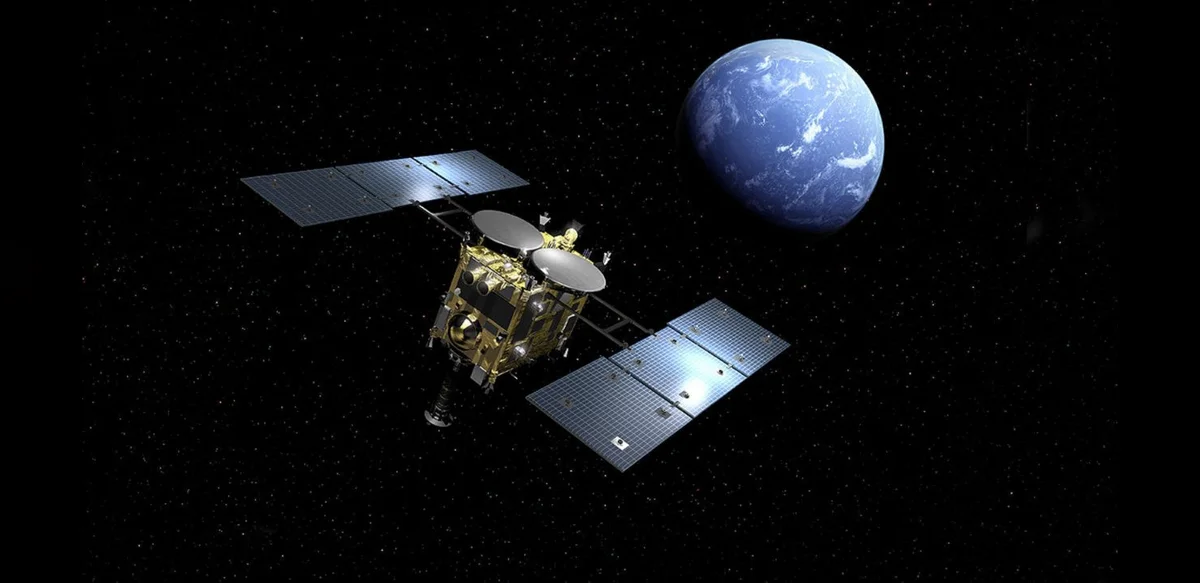
Japan’s Hayabusa2 spacecraft is preparing for one of the closest asteroid flybys attempted by such a mission, with the high-speed encounter set for July 5. The probe will come within as little as 1 km of the near-Earth asteroid Torifune, giving scientists a rare chance to examine a little-known space rock and test technologies useful for future planetary defence efforts.
Developed by the Japan Aerospace Exploration Agency, Hayabusa2 launched in 2014. It became one of the most successful asteroid missions after gathering samples from asteroid Ryugu and returning them to Earth in 2020. Though its main mission concluded with the sample return, the spacecraft continues to operate on an extended mission.
Mission officials say Hayabusa2 will pass between 1 and 10 km from Torifune at roughly 5.3 kilometres per second. During the short flyby, the craft will use onboard cameras and instruments to collect images and data on the asteroid’s composition, shape and surface.
At a recent meeting of NASA’s Small Bodies Assessment Group, JAXA’s Satoshi Tanaka called the manoeuvre one of the closest asteroid encounters attempted by a spacecraft of this type. The mission depends on advanced autonomous navigation to guide the probe past the asteroid at high relative speed.
Torifune, formerly known as 2001 CC21, is about 450 metres wide but remains poorly studied. It was later named after a figure from Japanese mythology. Researchers think it may resemble asteroid Itokawa, visited by Japan’s first Hayabusa mission, yet many details are still unknown.
Patrick Michel, a member of the Hayabusa2 science team, noted that scientists could find an unexpected object. The asteroid’s precise size and structure are uncertain and it might even be a contact binary formed by two smaller bodies merging gently.
Because of the high speed, the spacecraft will have only a brief window to gather images and measurements. Even so, the flyby will demonstrate rapid asteroid reconnaissance methods valuable for future planetary defence missions, such as those tested by the DART mission in 2022.
The Torifune encounter will not end Hayabusa2’s journey. During its extended mission the spacecraft has already observed zodiacal light and exoplanets. Its final target is asteroid 1998 KY26, expected to be reached in 2031. At roughly 11 metres across, it would be the smallest asteroid visited by any spacecraft, and mission teams are considering a possible landing attempt.

