


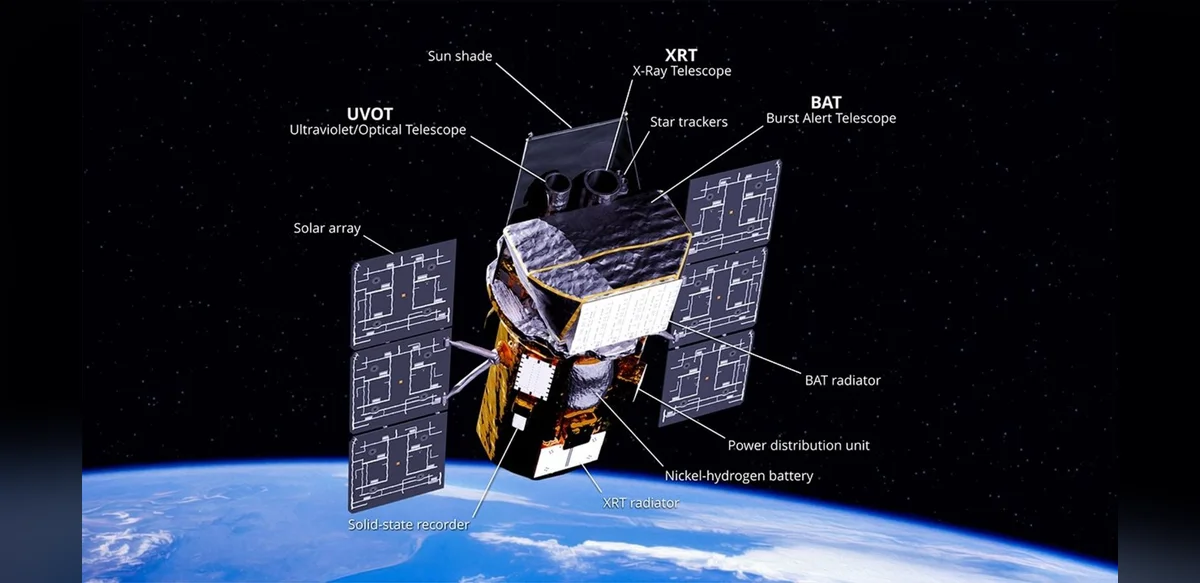
NASA is preparing a pioneering mission to rescue one of its oldest space telescopes before it falls back to Earth. The agency has approved a $30 million effort called Swift Boost to extend the life of the nearly 22-year-old Neil Gehrels Swift Observatory, which has already exceeded its original mission duration.
The plan raises a clear question: is it worth spending millions to save a telescope launched more than two decades ago? NASA maintains that the investment is justified.
Launched in 2004, the Swift Observatory was designed for a two-year study of gamma-ray bursts, the universe’s most powerful explosions. These events occur when massive stars collapse or neutron stars merge, releasing huge amounts of energy in seconds.
Swift was built for rapid response. It can detect a gamma-ray burst and automatically direct its X-ray and ultraviolet telescopes toward the event within minutes.
This speed makes Swift unique. While telescopes such as Hubble or the James Webb Space Telescope offer higher resolution, they require hours or days to reposition.
Swift serves as the first responder for astronomy, allowing observation of short-lived cosmic events.
Over the past two decades, Swift has contributed to many discoveries, including how heavy elements like gold and platinum formed in violent cosmic collisions. It also detected the Brightest Of All Time gamma-ray burst in 2022, the most powerful event recorded.
Solar storms have increased atmospheric drag, causing Swift to lose altitude faster than expected. Without intervention, the observatory could fall below a critical height by October and burn up in the atmosphere by year’s end. Unlike newer satellites, Swift has no propulsion system.
NASA selected Arizona-based startup Katalyst Space to perform the rescue using its Link servicing spacecraft. The craft is set to launch on June 30 aboard the final Pegasus XL rocket. After reaching orbit, Link will test its systems before attempting to meet Swift.
If successful, Link will use robotic arms to capture the observatory and raise it to a higher orbit over several months, potentially extending its life by at least five years.
The mission is ambitious because Swift was never designed for servicing. Engineers developed the spacecraft, robotic systems, and plan in less than a year.
NASA argues that replacing Swift would cost far more than the rescue. The original observatory cost about $250 million. For roughly one-eighth of that amount, the agency can preserve capabilities not available elsewhere.
Swift remains the only space observatory built for rapid gamma-ray burst detection. Its data also supports other telescopes by enabling quick observations of new events.
Losing Swift would create a gap in the ability to study fast-changing astronomical phenomena.
Risks include failure during approach, capture, or movement of a spacecraft never meant for docking.
Success would mark the first use of a commercial spacecraft to extend the life of a scientific observatory. The technology could later support repair, refueling, or repositioning of other satellites.
From NASA’s perspective, the mission offers a low-cost way to preserve a unique asset while testing technologies that may change future satellite operations. Even if the rescue fails, Swift would re-enter the atmosphere anyway.

