


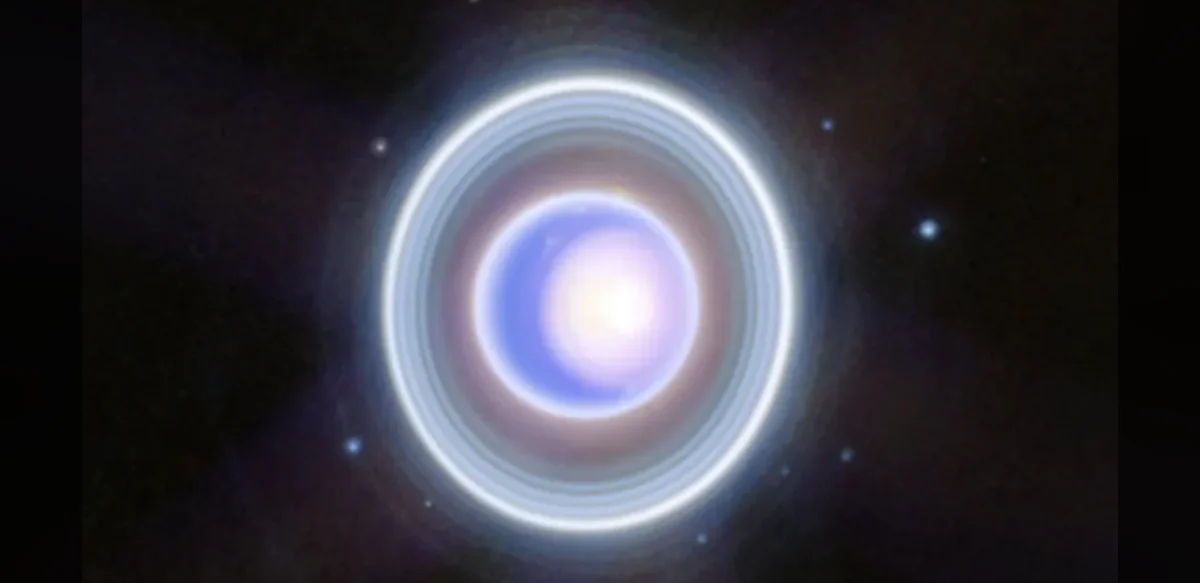
Uranus, the seventh planet from the Sun, is a cold ice giant that spins on its side and features a distinctive ring system unlike any other in the solar system. Its 13 rings were not detected until 1977, in contrast to Saturn’s prominent and bright rings. Recent studies of the outermost mu and nu rings offer insights into potential hidden moons.
Two Rings with Distinct Characteristics
A study led by Imke de Pater from the University of California, Berkeley, and published in the Journal of Geophysical Research: Planets, analyzed data from the James Webb Space Telescope, Hubble Space Telescope, and Keck Observatory to create the first combined reflectance spectra for these rings. The findings show the blue-tinted mu ring consists of water ice particles dislodged from a small moon called Mab by micrometeorite strikes. In comparison, the red-hued nu ring contains minerals mixed with 10-15% carbon-based organic materials, likely originating from nearby undetected small moons.
Uncovering Concealed Objects
The organic-rich dust in the nu ring implies the presence of faint satellite bodies orbiting among Uranus’s known inner moons, which current telescopes cannot yet observe. The enigma grew in 2025 with the James Webb Space Telescope’s detection of a new Uranian moon, S/2025 U1, measuring just 10 kilometers across, as reported by ScienceDaily. This suggests additional tiny objects may await discovery. Questions remain about why Mab is icy while inner moons are rocky. Experts believe a dedicated mission to Uranus could resolve these puzzles.

