

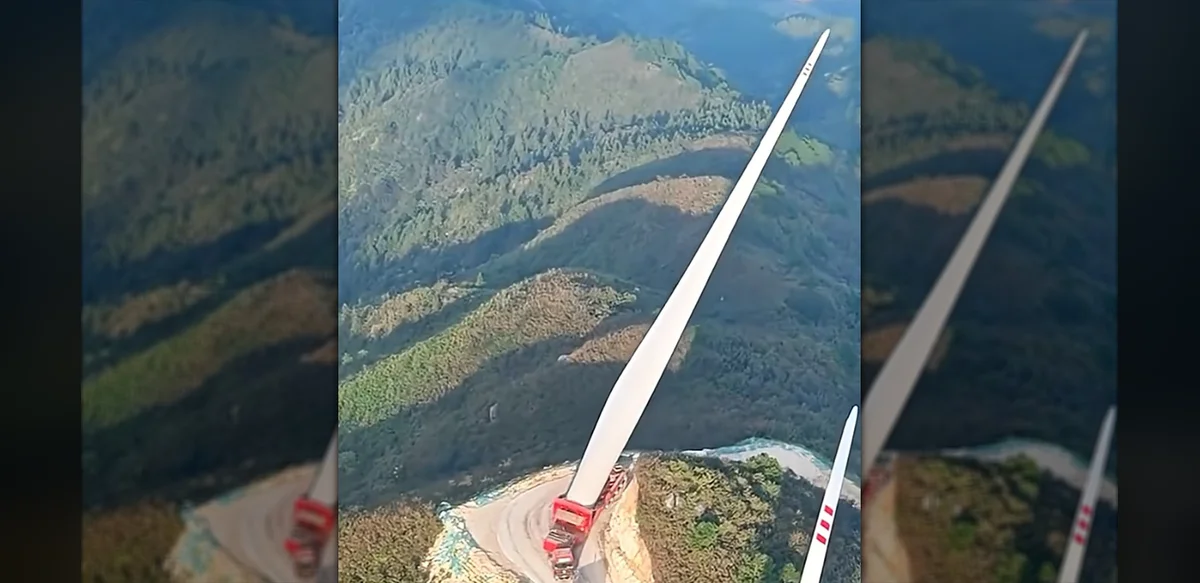
Moving oversized industrial equipment across difficult terrain requires exceptional planning and expertise. In remote highland regions, narrow roads with sharp curves and unpredictable weather create significant challenges for drivers and support teams. One recent operation involved hauling a wind turbine blade measuring 387 feet in length up steep inclines, highlighting the precision needed for such tasks.
The journey began at a lower elevation where the component was loaded onto a specialized multi-axle trailer. Engineers had mapped the route in advance, identifying potential obstacles such as tight switchbacks and areas with limited visibility. Support vehicles traveled ahead and behind to manage traffic and provide real-time updates on road conditions.
Wind played a major role throughout the ascent. Gusts could shift the load slightly, demanding constant adjustments from the driver. The blade extended far beyond the trailer, making every turn a calculated maneuver. Crew members monitored clearance from rock faces and guardrails, using hand signals and radio communication to guide the vehicle safely.
Steep gradients added another layer of complexity. The truck needed sufficient power to maintain momentum without overheating brakes on the descent portions that followed some climbs. Hydraulic systems helped distribute weight evenly, reducing stress on individual wheels. Safety protocols required frequent stops to inspect straps and connections.
Local authorities had closed sections of the road to regular traffic, allowing the convoy to proceed without interruptions. Residents in nearby villages watched from a distance as the unusual load passed by. The operation underscored the growing demand for renewable infrastructure in hard-to-reach locations.
Teams involved in these transports undergo extensive training. They practice scenarios involving sudden weather changes and mechanical issues. Coordination between drivers, spotters, and logistics coordinators ensures that decisions can be made quickly when conditions shift unexpectedly.
Environmental considerations also factor into route selection. Planners avoid sensitive habitats and minimize soil disturbance along the path. Temporary reinforcements may be added to bridges or road surfaces to handle the concentrated weight of the equipment.
Once the blade reached its destination at a higher elevation site, unloading proceeded under controlled conditions. Cranes positioned at the installation area lifted the component into place for assembly. The successful delivery marked the completion of one phase in a larger project aimed at expanding clean energy capacity.
Such transports demonstrate the logistical backbone supporting modern energy developments. Every mile covered reflects hours of preparation and the application of specialized knowledge. As projects move into more isolated areas, these operations are likely to become more common, requiring ongoing refinement of techniques and equipment.
Observers note that the visual scale of the blade against the mountain landscape emphasizes both the ambition of renewable initiatives and the human effort required to realize them. The process remains methodical, with safety as the primary concern at every stage.
Future improvements may include advanced sensors for real-time load monitoring and autonomous guidance systems to assist drivers. Until then, skilled professionals continue to handle these demanding assignments with focus and care, ensuring components arrive intact despite challenging environments.


