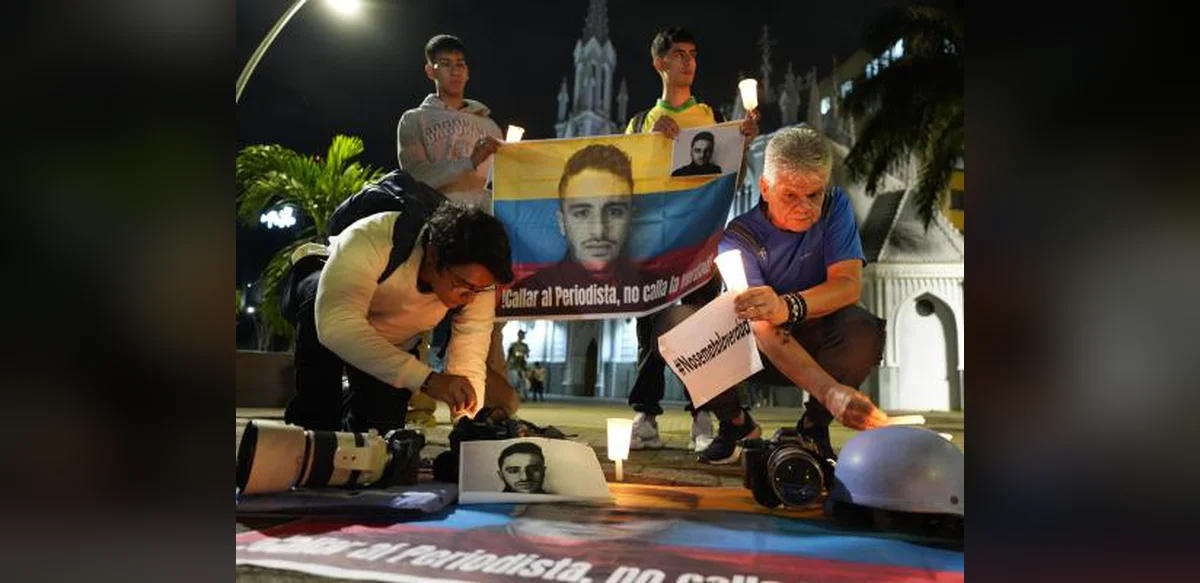
Mateo Pérez Rueda was close to finishing his political science degree with one internship left. The 24-year-old funded his work at the independent digital outlet El Confidente by delivering food by bicycle and selling fruit salads. On 4 May he went to Briceño in Antioquia province to cover the long-running clashes involving the army, paramilitaries and Farc dissidents. He stopped contacting his family the next day. After three days of uncertainty, a humanitarian team confirmed he had been abducted, tortured and killed by the Farc 36th Front. His death highlighted the rise in political violence to its highest level in ten years, placing the armed conflict at the centre of Sunday’s presidential vote. The contest pits left and right against each other with sharply different plans for ending a war that has killed nearly half a million people. Outgoing president Gustavo Petro supports left-wing senator Iván Cepeda, 63, who leads the polls and backs the government’s “total peace” policy of negotiating disarmament with all armed groups. Security analysts say the approach has faltered as factions used ceasefires to expand, yet Cepeda continues to defend it. His main rivals, far-right lawyer Abelardo de la Espriella, 47, and right-wing senator Paloma Valencia, 48, pledge an immediate return to full-scale military action. During the campaign, attacks, killings, abductions, displacements and massacres have increased sharply. Last year right-wing senator Miguel Uribe Turbay was shot at a rally and later died. The 2016 peace accord with most Farc factions cut violence for several years but did not eliminate it. Later governments delayed parts of the deal, while some Farc remnants and other groups rejected it and grew stronger. In Antioquia the conflict never stopped, said Jorge Rueda, Mateo’s cousin. Although factions claim political motives, most fighting now centres on cocaine production and trafficking, illegal gold mining, timber and local graft. On Monday more than 50 people died in clashes between two Farc dissident groups in Guaviare department, many of them teenagers forced into the ranks. Researcher Alejandro Chala noted that while casualty figures remain high, the violence is now more localised than before the accord, when the homicide rate reached 80 per 100,000 people; it is now about 26. Espriella argues the country must be rescued from crime, while Valencia calls for “total security” instead of “total peace”. Cepeda still leads polls but Espriella has recently overtaken Valencia. Many voters remain undecided, so a runoff on 21 June is possible if no one secures a majority.