


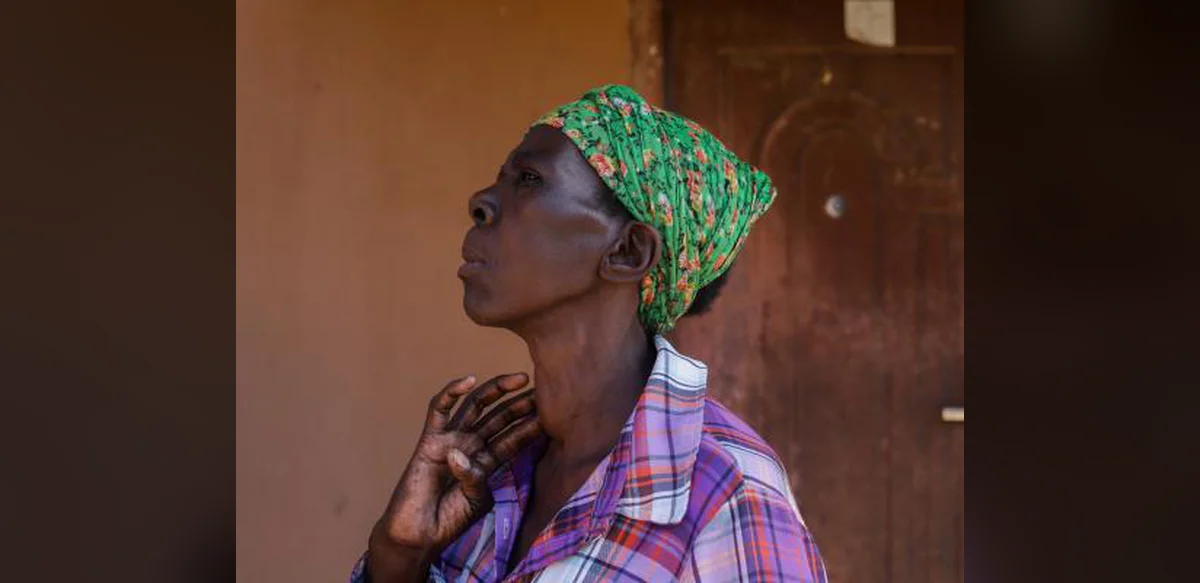
In late 2023, Boitumelo Mosege became ill. Her neck swelled, her body itched constantly, and she fainted often. Doctors diagnosed hyperthyroidism, forcing her to stop farming near Molepolole, a town roughly 50 kilometres northwest of Gaborone. Botswana offers universal free public healthcare, yet Mosege received medicine only at irregular intervals. The 53-year-old depends on occasional work by her four children and her mother’s monthly pension of 1,400 pula to cover 2,000 pula in monthly drug costs. By early May she had gone three months without purchasing any medication. “I felt like I had lost my life right there,” she recalled after learning she must pay for treatment herself. “I felt suicidal.”
Nearby, Kelly Jansen looks after her 83-year-old father, Gerhardus Jansen, who uses a wheelchair. They spend a third of his pension on medicines and equipment such as a blood-pressure monitor and compression stockings. The 39-year-old is seeking a donated electric wheelchair to regain some independence. “I want my life back,” she said.
Shortages of essential medicines prompted President Duma Boko to declare a public health emergency last year, ten months after his election victory ended decades of rule by the independence party. Health procurement had long been inefficient, but a prolonged economic slump triggered by falling diamond demand, which accounts for 80 percent of exports, pushed the system into crisis, Boko wrote in a February opinion piece. The downturn has also raised unemployment in one of Africa’s most stable and prosperous nations. Boko criticised the Central Medical Stores for inflating drug prices. University of Botswana health policy lecturer Thabo Lucas Seleke noted that problems at the agency had been documented since at least 2010, when an official report called for major reforms. “It is a breeding ground for corruption,” he said. “It has not improved; it is getting worse.” The health ministry did not respond to requests for comment.
At independence Botswana ranked among the world’s poorest countries. The discovery of diamonds a year later transformed its fortunes. For decades the landlocked nation recorded some of the fastest economic growth globally, enabling free primary and secondary education and strong progress against HIV/Aids. Its 2024 GDP per capita of $7,695 ranked fourth highest in Africa. Other health indicators, however, have lagged: maternal mortality remains higher than in countries with similar income levels.
Natural diamond prices have fallen 60 percent in four years amid rising sales of lab-grown alternatives. The IMF reported that Botswana’s economy contracted 3 percent in 2024 and 1 percent the previous year. Rising fuel costs linked to the US-Iran conflict will add pressure, as the country imports oil, noted political risk analyst Marisa Lourenço. Unemployment reached 21 percent in the year to March 2025, with nearly 29 percent of people aged 15 to 35 jobless.
Oratile Olorato Kgatle, 26, has applied for work in public relations for 18 months without a single interview. Limited to office roles by Erb’s palsy, she sought psychiatric help in January. “I could feel that light just dimming with each day,” she said.
Middle-class households have also been affected. Phenyo Tanka’s family stopped dining out and dismissed their domestic worker after her husband lost his mining engineering job in December. The 39-year-old mother of four holds an agriculture degree obtained in 2011 but has never found related employment. She now sells homemade cakes and plans to open a toilet-paper factory, hoping to show her two daughters the value of independence.

