


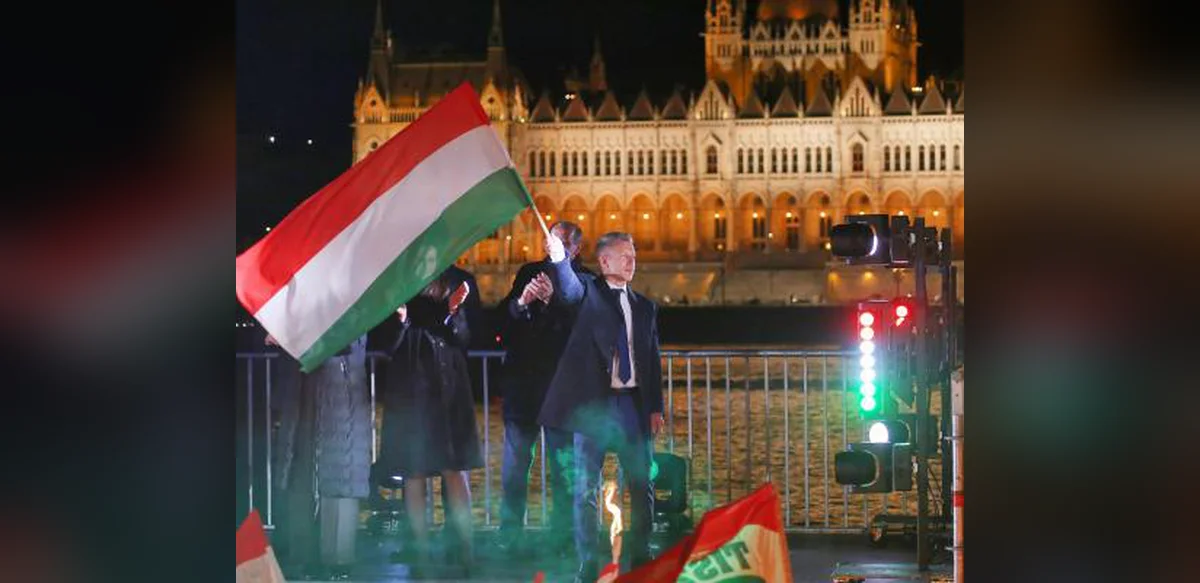
In Budapest, anticipation builds for Péter Magyar’s upcoming press conference, where he is set to address questions from international journalists. The event, scheduled to begin shortly, is taking place in a large theater-like setting, highlighting the widespread global attention on Hungary’s incoming prime minister and the shift away from Viktor Orbán’s leadership. This election stands out significantly in the region. Staff from the Tisza party are meticulously preparing, including ensuring flags appear pristine on stage.
In Brussels, the European Union plans to collaborate promptly with Hungary’s new administration to advance matters such as energy policies and the disbursement of withheld EU funds, according to the European Commission president. Ursula von der Leyen extended her congratulations on Magyar’s electoral success, emphasizing that Europe fully embraces Hungary and that its citizens have reaffirmed their commitment to European values.
Key discussions with the new government will cover rule-of-law improvements and anti-corruption measures to unlock €17 billion in frozen funds, as well as addressing Russian influence, the dispute over the Druzhba pipeline with Ukraine, and the €90 billion loan for Kyiv previously blocked by Orbán. In response to inquiries, von der Leyen stated that the EU aims to engage swiftly on these and other issues to deliver timely benefits for Hungarians.
She also highlighted the need for the EU to draw insights from recent events, advocating for a shift to qualified majority voting in foreign policy to prevent recurring obstructions. However, implementing this change may prove challenging, as even nations relieved by Orbán’s departure might hesitate to relinquish their veto rights on critical foreign matters.
Reporters shared insights on covering the election in Budapest, describing the atmosphere as akin to a major sports victory, with people celebrating joyfully in the streets – an unusual sight for political events.
As a young resident of Budapest, Péter Magyar once displayed a poster of Viktor Orbán, then a key advocate for democracy, in his room. This reflected his enthusiasm for the post-communist transformations. Now, at 45, Magyar has led the effort to remove Orbán, whose 16-year tenure turned the nation into a model of illiberal governance.
Magyar’s rapid ascent with the Tisza party has been remarkable. Analysts note that no political group in Hungary’s post-transition era has grown so quickly. Opinions about him vary: some commend his organizational skills and relentless campaigning, including multiple daily speeches, while acknowledging his occasionally sharp demeanor. Others view him as ideally suited for the current challenges, describing him as genuine and driven, though sometimes impatient – qualities seen as essential for recent progress.
This development represents a pivotal chapter for Hungary and has broader implications for Europe. The conclusion of a prolonged illiberal and anti-democratic phase calls for celebration, but the new government’s substantial majority brings significant duties. The EU must also reflect on its approaches. While relief is evident in European capitals and Brussels over Magyar’s win, the pre-election anxiety and reliance on the vote to resolve the ‘Orbán issue’ reveal a gap: the absence of a unified EU plan to counter internal democratic erosion.

