


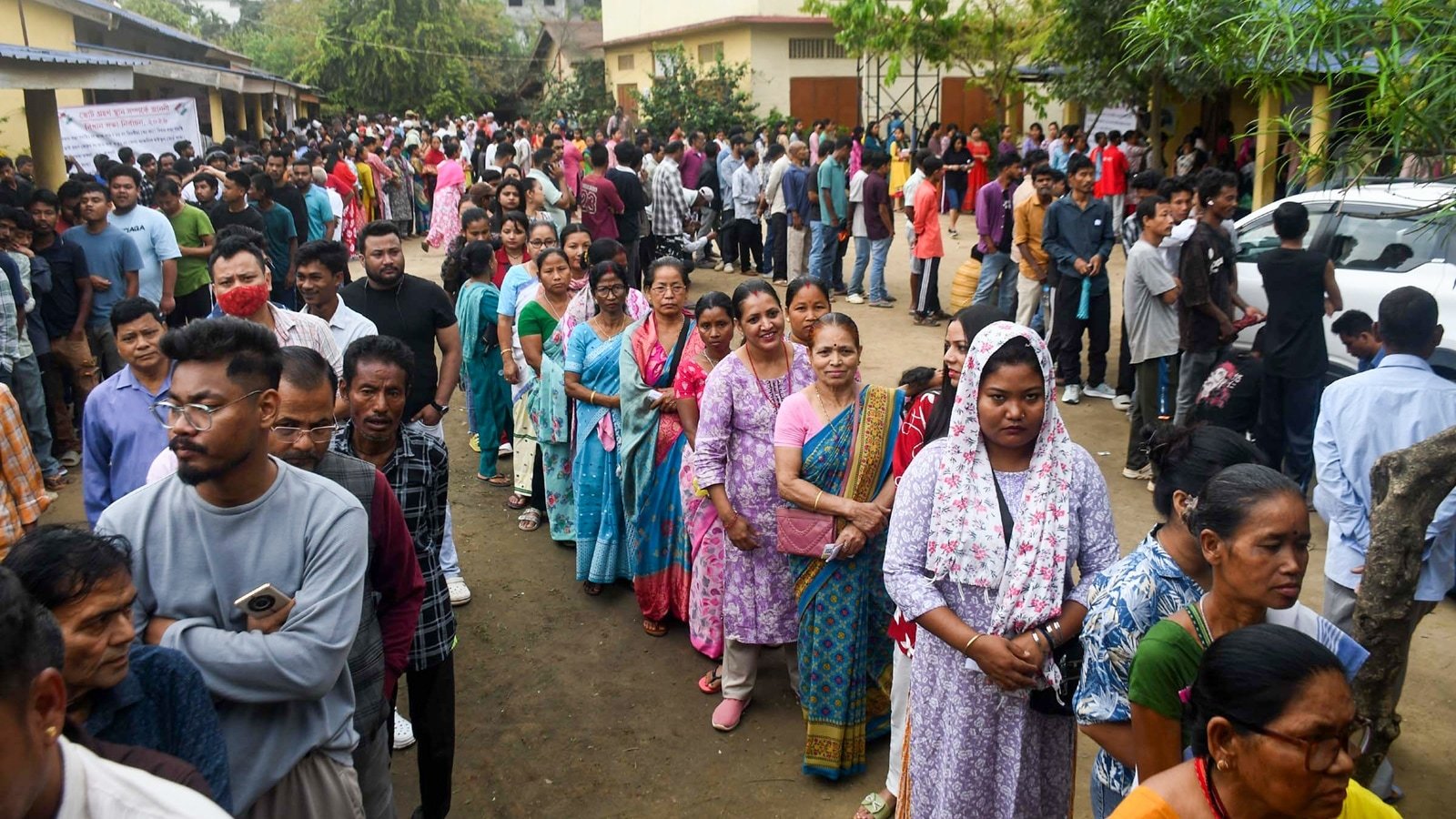
Following the conclusion of voting in Assam’s assembly elections, attention has shifted to the unprecedented voter participation rate. The ruling Bharatiya Janata Party (BJP) and the opposition Congress party both interpret the figures as beneficial to their sides. Analysts, however, identify multiple influences, including a targeted update of electoral rolls, strong voter engagement in a closely contested race, and a divided political atmosphere.
The state achieved its highest-ever turnout on polling day, with the Election Commission reporting 85.91%, a number that could rise in the final tally. This exceeds the prior record of 84.67% from 2016, when the BJP assumed control after 15 years of Congress rule.
Based on the Election Commission’s most recent data, 18 of the 126 constituencies saw turnout exceeding 90%.
The peak was 96.54% in Birsing Jarua, located in Lower Assam. Six additional areas—Chenga, Dalgaon, Gauripur, Jaleshwar, Srijangram, and Mankachar—surpassed 95%. These seven constituencies predominantly feature voters from Bengali-origin Muslim communities, which typically show high participation rates. Observers link this to concerns over citizenship and potential removal from voter lists.
During a Friday press briefing, Assam BJP leader Dilip Saikia emphasized the significance of elevated turnout in other regions.
‘We anticipated 96-97% voting in places like Chenga and Dalgaon,’ he noted. ‘But seeing nearly 90% in Nalbari (90.46%) or Tihu (87.02%) was unexpected. Even urban areas like Guwahati reached 75-77%, showing city dwellers kept pace with rural ones. Our core supporters voted more enthusiastically, and those who were previously reluctant stepped up for a stable administration.’
Saikia indicated that, per the party’s evaluation, high turnout could boost the National Democratic Alliance’s results in over 25 seats, forecasting a landmark victory for the incumbents.
In contrast, Assam Congress figure and Dispur contender Mira Borthakur Goswami referenced the common view that increased voting reflects dissatisfaction with the current leadership.
‘Voters queued from morning until evening seeking transformation,’ she stated. ‘Quiet supporters will back us, unable to endure the mismanagement and conduct of Chief Minister Himanta Biswa Sarma, with no other BJP leader in command.’
Yet, political analyst and Cachar College instructor Joydeep Biswas questioned this conventional interpretation for Assam’s case.
‘I view it as rivalrous participation fueled by division and the campaign’s intensity,’ he explained. ‘While minority groups often vote in larger numbers due to heightened concerns, others have been warned of risks to their heritage and survival. It’s a mutual competition.’
Fellow analyst and Gauhati University professor Akhil Ranjan Dutta highlighted the special voter list revision as a direct contributor. The final list, issued on February 10, showed a net reduction of 243,000 entries from the draft, due to deaths, relocations, and eliminations of duplicate registrations.
He also stressed competitiveness, particularly in party and candidate organizing, alongside community involvement.
‘Major parties are now highly rivalrous,’ he said. ‘The BJP maximized efforts to encourage voting. The opposition, especially Congress, showed renewed energy with strong leadership. Despite some key defections, this motivated activists. Ethnic groups in Assam have grown more engaged, often aligned with the government but also courted by challengers. Targeted communities are voting even more diligently. Together, these elements create a dynamic voting climate.’
Dutta specifically noted women’s involvement, with their turnout at 86.5%, compared to 82.01% in 2021. ‘Programs benefiting women have sparked exceptional participation among them.’

