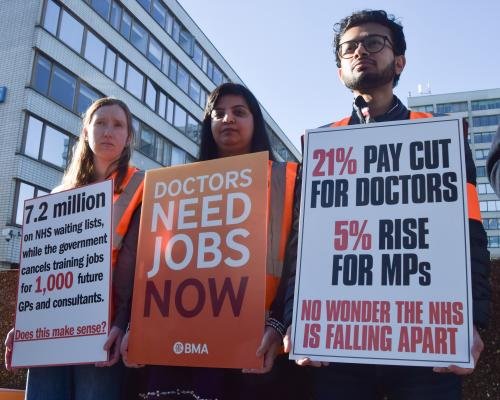
Government officials derailed the opportunity to resolve strikes by trainee doctors after abruptly lowering the financial proposal aimed at settling the dispute, according to the doctors’ representative. Dr. Jack Fletcher criticized the administration for engaging in tactics that compelled trainee doctors to initiate their 15th walkout over compensation and employment issues, causing disruptions to the National Health Service this week. As chair of the British Medical Association’s committee for resident doctors, Fletcher described a final dispute over funding as the critical factor that halted extended discussions, which had appeared poised to conclude a four-year conflict. Fletcher intensified his criticism of Health Secretary Wes Streeting, accusing him of making unfounded statements about the disagreement and eroding public confidence in physicians by depicting them as problematic due to their prolonged industrial actions. In a discussion with the Guardian, Fletcher indicated that trainee doctors—previously known as junior doctors—in England would continue striking until their authorization ends in August, unless Streeting agrees to a 26% salary increase and a substantial expansion of specialized training positions. He maintained that the physicians’ requests are fair, despite no other public sector employees pursuing equivalent full compensation recovery to restore real-term earnings to 2008 levels. Surveys indicate that public support, which initially backed the doctors’ demands during their first strike in 2023, has now shifted against the trainee doctors, whose salaries have risen by 28.3% in the past three years. The 15 strikes to date have incurred an estimated £3 billion cost to the NHS and required the rescheduling of numerous appointments and surgeries. Fletcher suggested that Streeting only enhances offers when strikes occur. He did not rule out monthly walkouts until August, a situation recently highlighted as a potential challenge for hospital leaders by NHS England’s chief, Sir Jim Mackey. However, he expressed willingness to restart negotiations with the health secretary following the current strike’s conclusion at 7 a.m. on Monday. Health trusts aimed to maintain 95% of standard services but faced difficulties due to staff absences for scheduled Easter breaks. Several facilities postponed procedures such as joint replacements. Fletcher asserted that negotiators from the government sabotaged a viable path to resolution after two months of talks in early 2024. He explained that the reversal happened when officials unexpectedly decreased the funding commitment for trainee doctors via changes to the salary advancement system, which determines pay increases based on experience, in response to the 26% demand. The Department of Health and Social Care contested Fletcher’s version, stating it inaccurately reflects the discussions. The disagreement that prompted the association to exit talks focused on the extra earnings from pay structure reforms and their timing. The committee sought greater immediate payments than the government offered. Fletcher noted that he and his team had invested eight weeks exploring a salary framework that could resolve the issue. But at the final stage, officials not only cut the overall funding but also extended it over a longer period, insisting on a three-year rollout. He described this as the catalyst for the strikes. A department spokesperson rejected Fletcher’s narrative, expressing regret that the association persists in distorting events from talks held in good faith. They clarified that the proposal, which would have improved trainee doctors’ positions by an average of 35.2% compared to four years prior, was always structured as a three-year arrangement. They added disappointment over the lack of alternative suggestions from the association, which instead proceeded with strikes, though the secretary remains open to dialogue. Sources indicate trainee doctors were proposed £700 million in additional compensation over three years, distributed as £150 million in 2026-27, £250 million in 2027-28, and £300 million in 2028-29. Prior discussions involved a two-year plan with higher annual amounts, according to Fletcher. Committee members were outraged by what they viewed as a violation of prior understandings, leading them to suspend talks and strike. During those two years, negotiations covered figures exceeding £150 million and £200 million.