


The National Democratic Alliance administration did not succeed in passing the Constitution (131st Amendment) Bill, 2026, in the Lok Sabha. This outcome also made two related bills—the Delimitation Bill, 2026, and the Union Territories Laws (Amendment) Bill, 2026—ineffective. Although this did not result in the prime minister or cabinet resigning, it represented a significant political setback. It highlighted criticism of the government’s approach to undermining parliamentary processes and ignoring established rules.
This event also served as opposition to the shift toward a new national framework that deviates from the original bipartisan vision at independence. Marking the first defeat for the government in 12 years since Prime Minister Narendra Modi took office, it could have lasting implications.
For opponents, who have frequently been ineffective, this blocked the prime minister’s unilateral agenda without broader consultation. It was an unusual instance where varied opposition groups united throughout the process.
Despite attempts by the Bharatiya Janata Party to divide them, these leaders set aside rivalries and collaborated, especially on a constitutional amendment requiring a two-thirds majority, which the government lacked despite its numbers. The question remains if this unity will persist beyond isolated events.
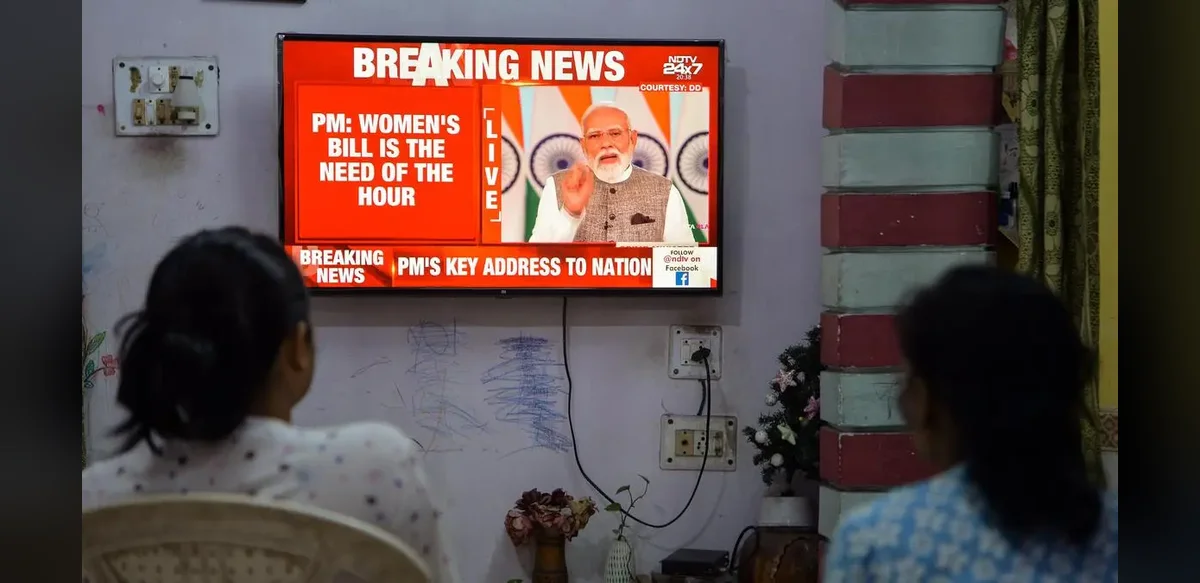
Unwilling to concede easily, Modi addressed the nation the next day, framing the bills as steps to implement the Nari Shakti Vandan Adhiniyam before the 2029 elections, while concealing broader changes to the parliamentary structure.
In the speech, he employed strong rhetoric, accusing opposition parties, particularly the Congress, which was mentioned 59 times according to its president Mallikarjun Kharge. He used public broadcasters for what amounted to a partisan message.
Traditionally, such national addresses are non-partisan and focused on key democratic issues. Modi deviated from this norm, unlike most predecessors, even during election code periods.
His language included dramatic terms like foeticide, sin, and punishment, resembling campaign speeches. This could have been delivered at party events in states like West Bengal or Tamil Nadu with similar coverage. Yet, he chose an official format, perhaps due to weak arguments.
Despite the ruling party’s strong majorities in 2014 and 2019, the government has retreated before, such as repealing farm laws amid widespread protests.
This recent failure is notable as the first time a major constitutional amendment was defeated on the House floor due to insufficient support. It establishes a precedent, clarifying that the BJP may face challenges ahead.

