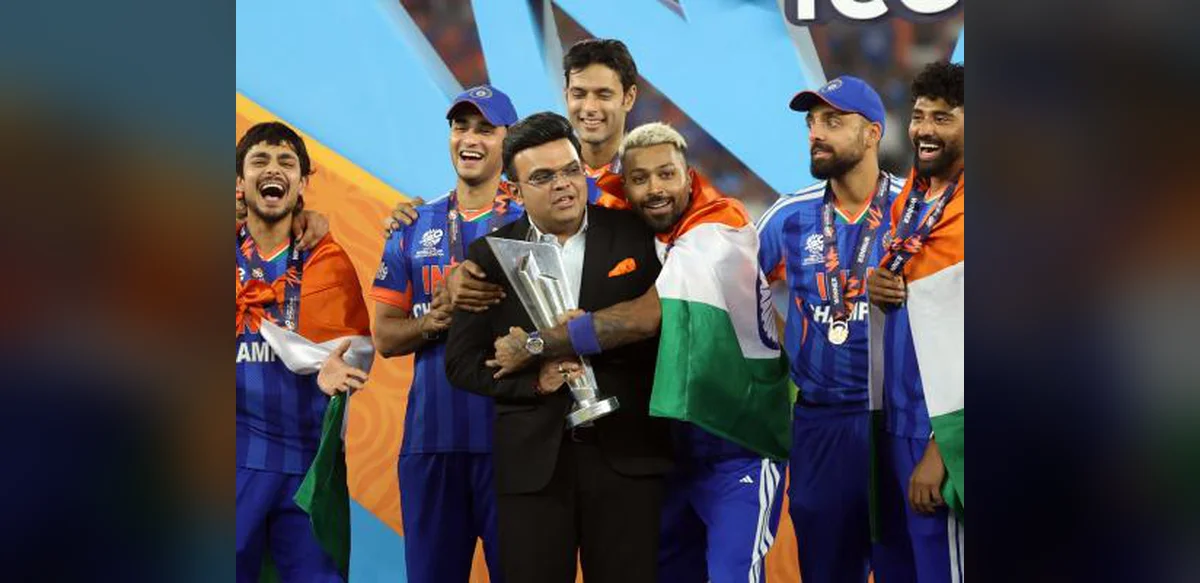
The Board of Control for Cricket in India shared a social media update describing ‘images the entire country will cherish forever,’ featuring a brief video of the festivities following India’s T20 World Cup win in Ahmedabad last month. The clip highlights the team’s remarkable performance, which allowed them to leave out talents like Shubman Gill and Yashasvi Jaiswal while scoring 255 runs to defeat New Zealand in the final. However, the footage centers heavily on Jay Shah, the International Cricket Council chair, dressed in a suit. He appears in numerous scenes hugging players, standing with head coach Gautam Gambhir, smiling alongside former captains Rohit Sharma and MS Dhoni, and even posing alone with the trophy before assisting Suryakumar Yadav in raising it. Although no longer the BCCI’s honorary secretary, Shah now oversees the global sport. Yet in this narrative, he emerges as the main character in an event that was not his own. This kind of display is typical for the 37-year-old administrator, who has held significant roles for years. He took over as BCCI secretary in 2019 and advanced to ICC chair five years later. His influence is amplified by his family ties: his father, Amit Shah, serves as India’s home minister and a close ally of Prime Minister Narendra Modi. This authority is amplified through social media channels of the sport’s international body and its dominant national organization. For instance, during last year’s World Test Championship final at Lord’s, where South Africa overcame their reputation for faltering in big moments to claim a world title, the ICC released a video montage dominated by Shah. It included slow-motion shots of him in the audience, even focusing on the back of his head, interspersed with the decisive plays. Another ICC video tracked his activities on the first day, showing him surrounded by prominent figures in cricket. When the Indian Express recently ranked Shah 22nd on its list of the 100 most influential Indians—up from 24th the previous year—the ICC shared the announcement on X with a complimentary note: ‘Power and duty are intertwined. This honor is fitting and will inspire our chair @JayShah to aim higher for cricket.’ The BCCI created its own visual to highlight the rankings of players like Jasprit Bumrah, Virat Kohli, and coach Gambhir, all placed far below Shah. This portrayal suggests cricket benefits from an exceptional leader elevating it to new levels. Shah can highlight achievements like launching the groundbreaking Women’s Premier League under his BCCI tenure, the success of India’s national squads, and building a massive stadium in Gujarat named after his father’s political colleague. Now at the helm, he faces numerous challenges and unanswered queries. While promotional visuals abound, substantive statements are rare. His acceptance speeches are accessible, but in-depth interviews are uncommon. What is his precise plan for the sport? What do those ‘higher objectives’ entail? Upon his election, a BCCI release mentioned his focus on preserving Test cricket, advancing women’s cricket, and increasing inclusivity—positive sentiments lacking specifics. Currently, the emphasis remains on showcasing Shah, which might be more palatable if cricket’s administration were robust. However, a report from the World Cricketers’ Association last year paints a different picture, decrying the disorganized fixture list that strains relations between international and league cricket, uneven revenue sharing by the ICC, and a lack of true oversight. The document states, ‘No entity truly oversees the sport as a dedicated guardian of the global game,’ and suggests an independent panel to advise the ICC board. The fact that players’ representatives produced this critique underscores the problems. These concerns persist a year later, amid ICC tournaments disrupted by political issues. During the recent event in Ahmedabad where Shah celebrated on the pitch, the competition suffered from Bangladesh’s exclusion—prompted by the BCCI’s decision to pull Mustafizur Rahman from the Indian Premier League—and Pakistan’s hesitation to face India. Cricket urgently requires firm, open leadership, and stakeholders deserve clarity on the top official’s strategies. For now, the focus is on those memorable images. It would be beneficial to hear more substantive input.