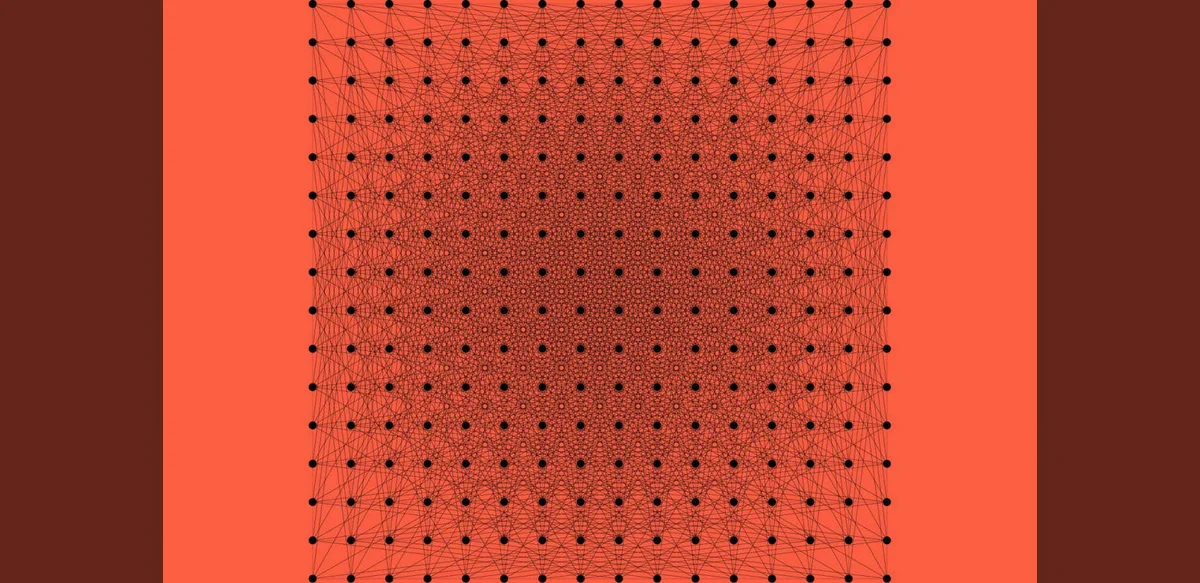
An artificial intelligence system developed by OpenAI has resolved an 80-year-old mathematical conjecture originally posed by Paul Erdős. The achievement involves the planar unit distance problem, which explores the maximum number of equal-length connections possible between points on an infinite plane. Experts have described the result as a significant advance for artificial intelligence in the field of mathematics. Mathematicians including Misha Rudnev of the University of Bristol noted that they did not anticipate a solution during their lifetimes. Tim Gowers of the University of Cambridge called the work a milestone in AI-assisted mathematics and indicated it would merit acceptance in a leading journal if submitted by a human researcher. The AI approach drew on methods from algebraic number theory to construct higher-dimensional structures before projecting them into two dimensions. This produced a counterexample showing that certain non-symmetric arrangements allow more connections than Erdős had conjectured. Researchers such as Will Sawin at Princeton University and Kevin Buzzard at Imperial College London have reviewed the solution and confirmed its validity, though they noted its complexity. The development has prompted additional human work building on the same techniques.