


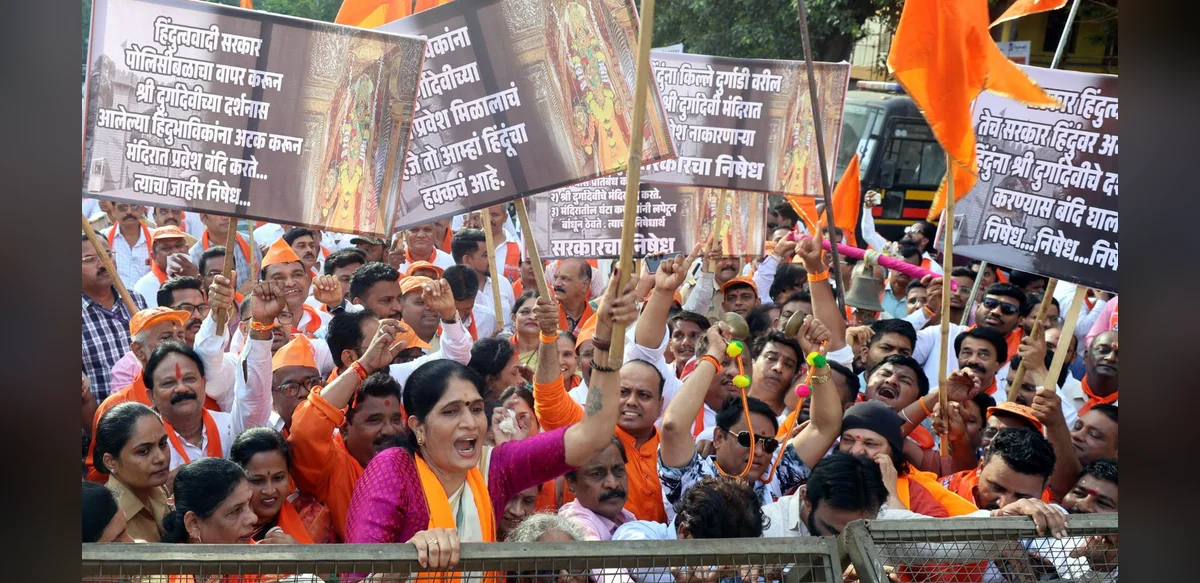
Nearly six decades after the Durgadi Fort issue first emerged as a focus for Shiv Sena’s Hindutva activities, the historic Kalyan location again became a point of conflict on Wednesday. Rival Sena groups and BJP supporters clashed with police over limits on temple access during Bakrid prayers. The incident has renewed a long-standing disagreement about ownership, worship rights and political meaning at a fort site that contains both a mosque and a temple and ranks among Maharashtra’s most delicate religious matters.
The direct cause of the latest clash was a short-term limit on entry to the temple inside Kalyan’s Durgadi Fort during Bakrid prayers on Wednesday morning. Each year during Eid-ul-Adha, prayers take place on the road to the fort and temple access is briefly stopped for security reasons.
This year, however, members from both the Uddhav Thackeray-led Shiv Sena (UBT) and the Eknath Shinde-led Shiv Sena resisted the limits, calling for Hindu worshippers to have continuous entry to the temple even during the prayer time.
Police reported that the temple stayed closed for about 30 minutes during the prayers, after which protests broke out near the fort area. Sena (UBT) members led by Vijay Salvi held “Ghantanad” protests and performed maha aarti events, while BJP corporator Mahesh Patil opposed prayers on roads and cautioned officials against limiting temple access. As tensions rose, police held Patil, blocked roads to the fort and placed heavy security in the Lal Chowki area to stop further escalation.
On Bakri Eid, the Muslim community holds prayers at the base of Durgadi Fort. During this time, Hindu worshippers are barred from entering Durgadi Fort.
What is the Durgadi Fort
The Durgadi Fort, situated in Kalyan roughly 50 kilometers northeast of Mumbai, carries important historical mentions from the 16th century when Kalyan served as a key trading port under Muslim rule due to its nearness to the Arabian Sea.
The fort, once a major landmark of Kalyan, was called “the shelter for the world” and spanned about 70 acres. It stood at the northeastern edge of the city, raised on high ground beside the river. Records indicate the fort has existed since 1570, and early accounts show it contained a “Musalman tomb, prayer place, and other buildings.”
A detailed account from the Gazetteer of the Bombay Presidency: Thana (1892) describes the fort’s features:
“On the top of the mound, on the west crest which overhangs and is about 100 feet above the river, is the Prayer Wall or Idga, sixty-four feet long, thirteen high, and seven thick, and near the east crest of the mound a mosque, twenty-two feet long, twenty-two high, and twenty broad. About thirty yards from the mosque is a round cut stone well of great depth, eleven feet in diameter, with a wall two feet seven inches thick at the top,” it notes.
In 1760, Kalyan was captured by the Marathas, who made major changes to the fort. The Marathas constructed a small wooden temple dedicated to the goddess Durgadevi inside the fort and renamed it Durgadi Killa, a name it keeps today.
“In the citadel the Marathas built a small wooden temple of Durgadevi behind the mosque, and called the fort Durgadi Killa in honour of the goddess, a name which it still bears. They also changed the Jama mosque into Ramji’s temple,” the Gazette states.
Later the British took Kalyan in 1818 and the Gazette notes that the temple stopped being a place of worship after the image of the goddess was taken.
“At present there are, on the mound at the north-west corner of the fort, the prayer-place and the mosque-temple, which has ceased to be a place of worship, since 1876 when the image of the goddess was stolen,” the Gazette states.
The origins of the controversy
The current dispute over Durgadi Fort goes back to the mid-1960s, when local Kokni Muslims said they had been offering Eid prayers at the site for generations and that families such as the Mirsinghes held the land around the Idgah and mosque.
The matter grew after local Hindu groups challenged Muslim control over the site and sought equal rights to worship there.
In 1966, the Maharashtra government intervened, stating that the land belonged to the state and suggesting to transfer part of it to the then Kalyan Municipal Council for development of a public park. The step sparked protests from the Muslim community, particularly the

