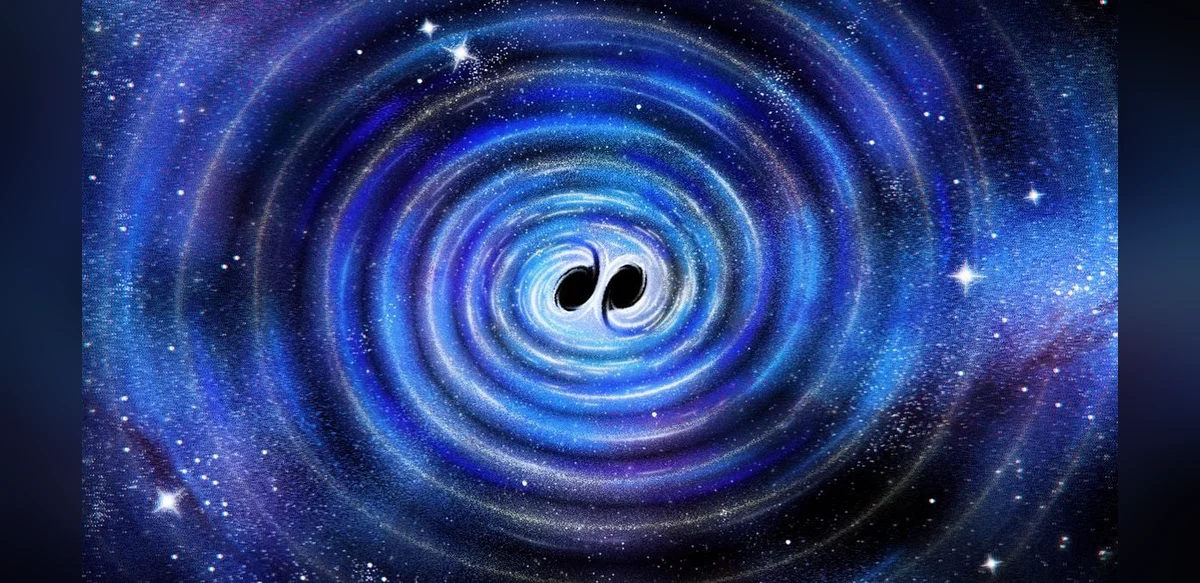
Few cosmic objects puzzle scientists more than black holes. In recent years gravitational wave detectors have uncovered them in unexpected forms, including unusually large masses, rapid rotations, and oddly paired systems. The newest catalog from the LIGO-Virgo-KAGRA network now supplies nearly four hundred events, allowing researchers to study the overall population rather than isolated cases. The findings point to multiple formation channels operating across the universe. Astrophysicist Sharan Banagiri notes that some black hole pairs likely arise from a single collapsing gas cloud, others from chance encounters inside dense star clusters, and still others from earlier mergers. Black holes trap all light because their gravity curves spacetime so severely that escape is impossible. They originate when the cores of sufficiently massive stars collapse. The first direct detection of gravitational waves in 2015 opened a new observational window, and the current catalog records roughly forty events each year. With this volume of data, analysts can now examine statistical patterns in masses and spins. Key highlights include the clearest signal yet, GW250114, and the most precisely located event, GW240615dg. Mass distributions cluster around ten and thirty-five solar masses. The higher group may represent second-generation objects produced by repeated mergers, a process supported by the prevalence of fast spins. These collective results sketch an entire population shaped by several distinct pathways rather than a single mechanism.