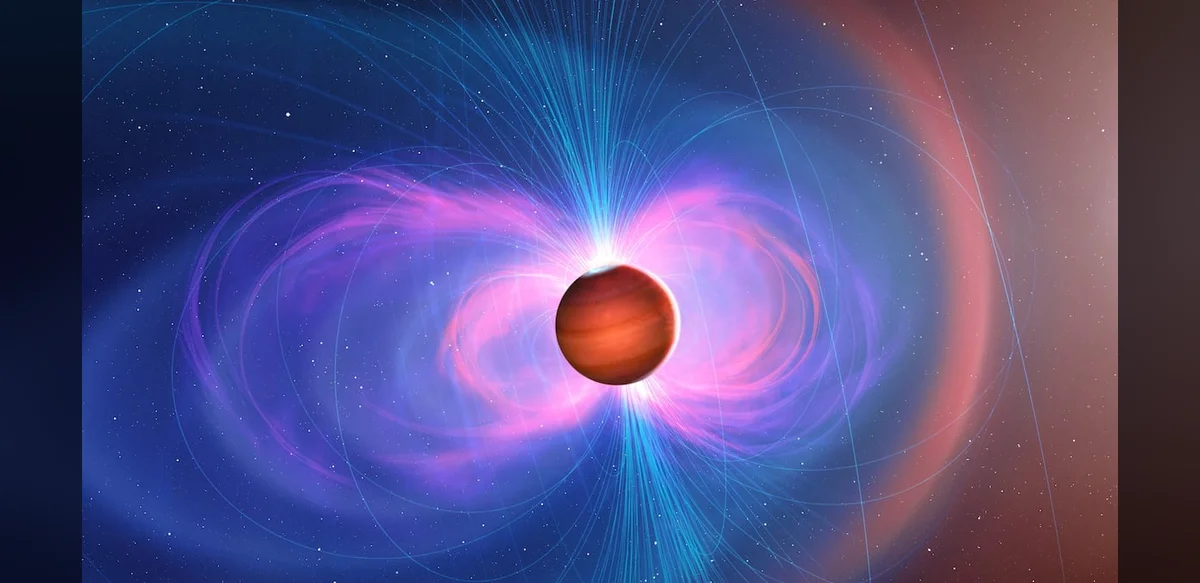
The hottest giant planets should theoretically feature the strongest winds. Higher temperatures ought to drive more intense atmospheric flows, and hot Jupiters represent the warmest known worlds. These planets circle their stars at extremely close distances, causing some to lose atmosphere due to intense heat. Yet recent examination of seven such planets found wind speeds notably slower than predicted. Researchers led by an astronomer at Côte d’Azur Observatory propose that a braking mechanism is at work, most likely magnetic fields. If confirmed, the reduced winds would offer the clearest indication yet of magnetic activity beyond the Solar System. The discovery provides a fresh approach to studying exoplanets by comparing their magnetic conditions, advancing efforts to identify worlds capable of retaining water and supporting life. Hot Jupiters orbit so near their stars that some complete a circuit in under a day. Most are tidally locked, creating permanent day and night sides that generate sharp temperature differences and vigorous weather. Equilibrium temperatures reach several thousand degrees, which should further intensify circulation. Direct measurement of magnetic fields remains impossible, but earlier work traced atmospheric iron vapor to determine wind speeds. Since magnetic fields can slow charged gases, the team used wind data as an indirect indicator. Observations with the MAROON-X instrument on Gemini North and ESPRESSO on the Very Large Telescope covered seven planets. Recorded speeds ranged from two to seven kilometers per second, far exceeding Jupiter’s maximum of 0.4 kilometers per second. The data revealed an inverse relationship: hotter planets exhibited slower winds. Alternative explanations for reduced speeds would predict the opposite trend. The findings suggest magnetic fields of a few gauss, similar to Jupiter’s strength. Additional observations are needed to verify the results. The study demonstrates progress from single-planet descriptions toward broader statistical patterns in exoplanet behavior.