


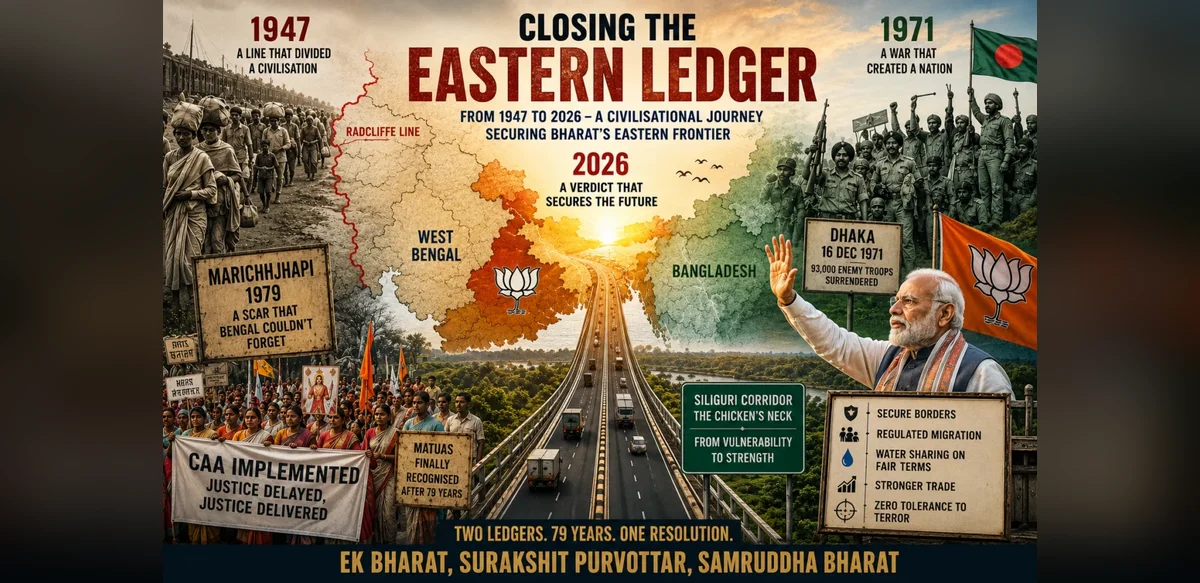
May 4, 2026 may be seen as more than an election win for the BJP. It could mark a key point in India’s long process of civilisational and strategic integration. Events in West Bengal went beyond the end of an established political order. They reflected currents that began with the Partition of India and the Bangladesh Liberation War. The result appears to close two long-standing issues on India’s eastern frontier.
The Radcliffe Line was drawn quickly under Cyril Radcliffe. It split communities, displaced millions and left lasting demographic and political divisions. Bengal felt this break deeply. Refugee movements, especially among groups such as the Matuas, became lasting experiences of displacement and limited political voice.
These populations stayed on the edge of electoral calculations for years. The Left Front government and later Mamata Banerjee’s administration did not fully bring them into a national framework. The 1979 Marichjhapi events remained unaddressed in public memory while their effects continued.
The 1971 war turned Bengal into the base for a new state. The violence of Operation Searchlight and the refugee movement into India created both humanitarian needs and strategic demands. India intervened under Indira Gandhi, leading to Bangladesh’s independence. Bengal served as the platform for that change.
Later decades brought porous borders, migration concerns and political choices that often favoured short-term gains. The eastern frontier stayed sensitive yet divided.
After 2024, the removal of Sheikh Hasina in Bangladesh and new leadership under Muhammad Yunus added uncertainty. India’s actions following the Pahalgam attack and Operation Sindoor showed a firmer security stance. The eastern region gained fresh attention.
The 2026 result fits this setting. Applying the Citizenship Amendment Act in border areas went beyond routine procedure. For Matua communities it addressed a long-delayed matter from 1947. Citizenship served here as a means of regional stabilisation.
The BJP’s large majority produced more than a government change. It aligned state politics with central strategy. West Bengal had acted as a partly independent buffer in eastern calculations. Security issues such as fencing, migration, water talks and intelligence work often passed through state priorities. That buffer has now ended.
Unified policy can now advance. Border work becomes more systematic, with fencing, surveillance and agency coordination free of earlier friction.
The Siliguri Corridor, known as the Chicken’s Neck, gains new focus. This narrow link to the northeast states has long been a weak point. With political agreement between Delhi and Kolkata, it may shift from vulnerability to a strengthened route through expanded roads, rail and logistics.

