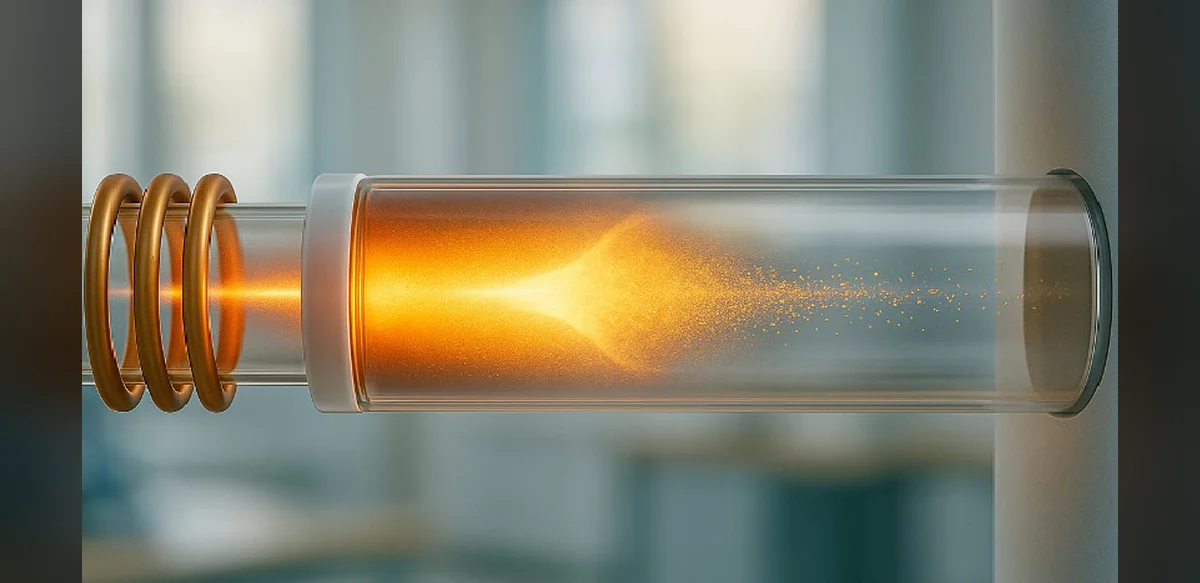
Nuclear fallout, whether from deliberate or accidental events, remains a scenario authorities aim to prevent. Yet preparing for such incidents requires detailed knowledge of their effects for safety and response planning. Scientists at Lawrence Livermore National Laboratory conducted controlled tests inside a high-temperature plasma tube to mimic part of a nuclear fireball and observe how vaporized fission particles behave during cooling. They used uranium, cesium, and cerium as starting materials, with the latter standing in for plutonium. Two cooling patterns were tested: steady temperature decline and prolonged high heat followed by rapid drop. Results showed uranium and cerium condensed early in both cases, though compound formation varied slightly. Cesium behaved differently, condensing later and forming more complex mixtures when high temperatures persisted longer. These observations can aid both forward planning and backward analysis of real events by revealing formation conditions preserved in particles. The work contrasts with traditional equilibrium models that assume stable reactions and may overlook cooling-rate effects. While the setup remains simplified and involves no actual nuclear reactions, it offers a controlled way to study mechanisms and can be combined with other models. Findings may also apply to other extreme heat environments and allow future expansion to include additional materials such as concrete or soil.