


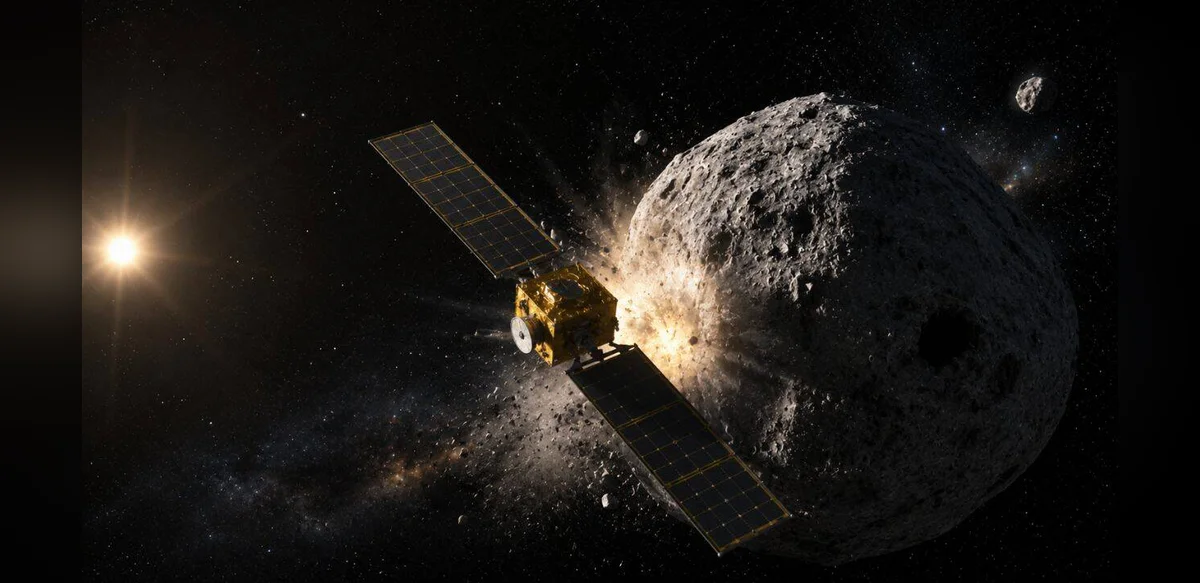
In September 2022, NASA performed the first test of deliberately striking an asteroid to alter its course. The target was Dimorphos, a small body circling the larger asteroid Didymos. Neither posed a threat to Earth, making them suitable for the experiment. The Double Asteroid Redirection Test spacecraft hit Dimorphos at about 14,000 miles per hour. Two weeks later, observations confirmed the outcome, marking the first successful use of asteroid deflection technology for planetary defense.
The mission tested kinetic impact, where a spacecraft delivers momentum to change an asteroid’s path. Before impact, Dimorphos orbited Didymos in 11 hours and 55 minutes. NASA set a minimum success goal of a 73-second change in orbital period. The asteroids were 6.8 million miles from Earth during the test, allowing safe data collection for future defense planning.
After the 26 September collision, telescopes measured the shift by tracking brightness changes as the bodies eclipsed each other. Radar stations in California and West Virginia provided additional data. Results announced on 11 October showed the orbit shortened by 32 minutes to 11 hours and 23 minutes, with a two-minute uncertainty. This exceeded the success threshold by over 25 times.
NASA Administrator Bill Nelson called the event a key moment demonstrating readiness against space threats. Planetary Science Division director Lori Glaze noted it advanced understanding of collision effects and future applications. Debris ejected from the surface contributed significantly to the deflection beyond the spacecraft’s direct impact.
In about four years, the European Space Agency’s Hera mission will examine the crater and measure Dimorphos’ mass to refine models for protecting Earth from hazardous asteroids.

