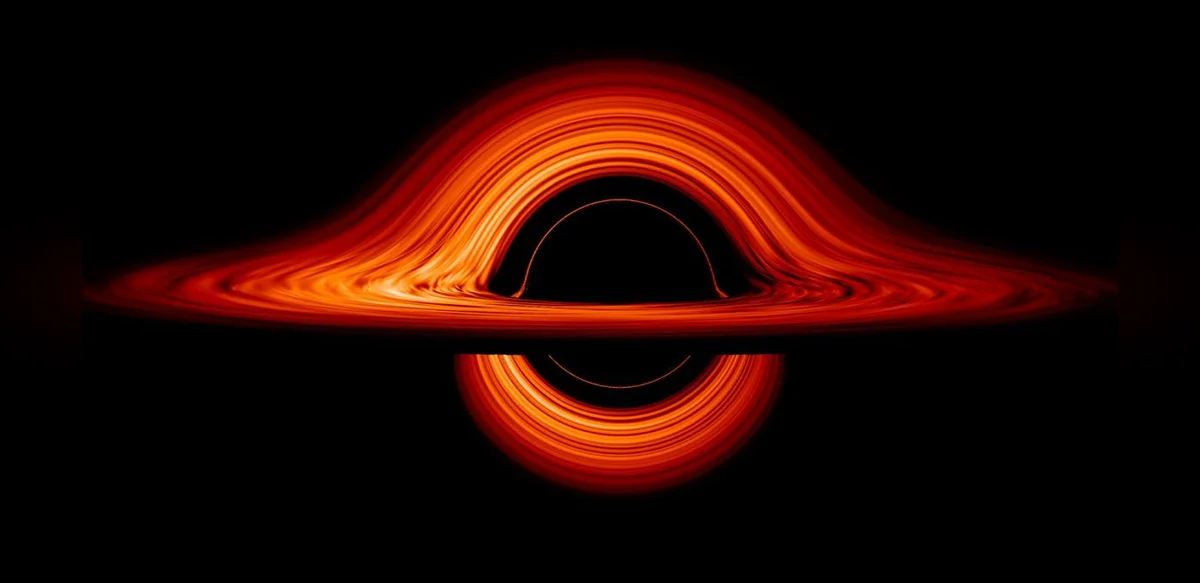
It is well established that nothing can escape a black hole. Yet a gravitational wave from a collision of two large black holes may have delivered the first direct indication of an event horizon. Researchers had predicted that a specific type of wave could reveal properties of this boundary. They now report detecting such a signal. The event horizon marks the limit beyond which gravity prevents anything, including light, from escaping. It cannot be observed directly because it neither emits nor reflects light. All knowledge of it has come from indirect effects on surrounding space. Gravitational waves offer another way to study these regions. These ripples in spacetime arise when black holes merge and can be measured on Earth. The signal includes an inspiral phase followed by a ringdown, in which the new black hole vibrates. Certain modes in this ringdown are tied to areas outside the horizon. Theory now points to an additional wave that originates closer to the horizon itself. This wave oscillates at roughly twice the horizon’s rotation rate and fades rapidly. The team examined data from an unusually strong event, GW250114. After careful analysis, the pattern matched predictions for the direct wave. The finding provides a new method to examine black hole boundaries through gravitational wave observations.