


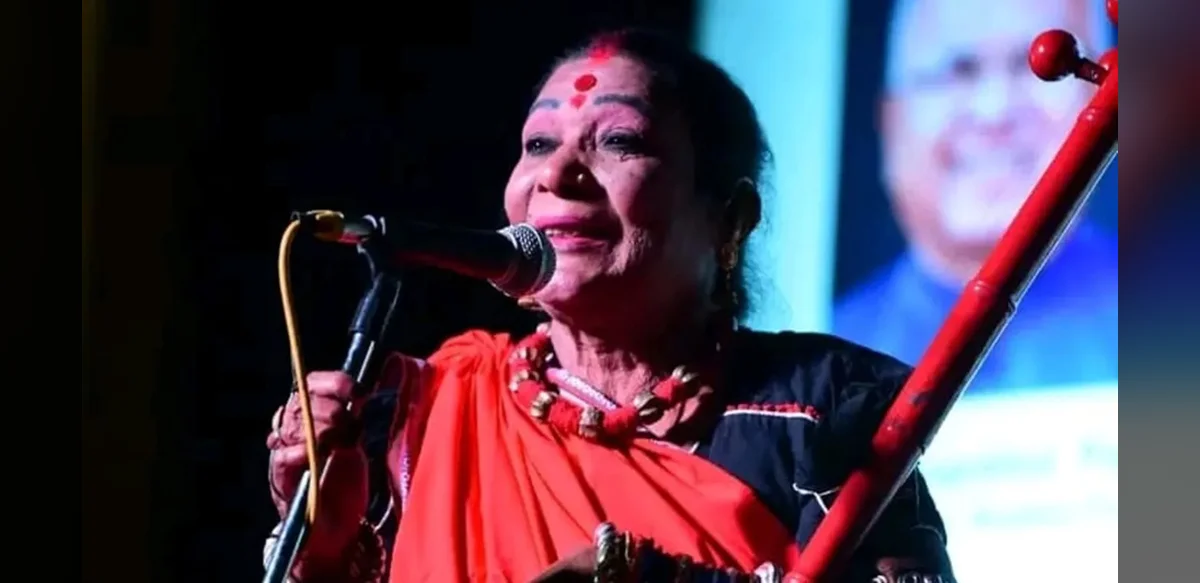
As a young girl Teejan Bai faced physical punishment from her father for attempting to sing Pandavani, the family folk tradition. No woman in the Pardhi community had previously performed this style outside the home, an act viewed as improper. Despite family opposition she left home for Chandrakhuri village near Raipur in Chhattisgarh. The choice distanced her from her community yet altered the path of Pandavani. She later became one of its most recognized practitioners.
Teejan Bai, the Pandavani singer who overcame long-standing restrictions and became the first woman from her Pardhi background to present the form on wider stages, died early Sunday at AIIMS Raipur following extended illness. She was 70 and had been unable to speak for several months, relying on gestures to communicate. Her work helped turn an oral tradition of Chhattisgarh into an art recognized beyond India.
Pandavani is a performance style in which artists sing and dramatize episodes from the Mahabharata. It began in Chhattisgarh and is also known in Madhya Pradesh and Odisha.
Born in Ganiyari near Bhilai, Teejan Bai heard her mother’s devotional songs and her grandfather’s Pandavani recitals. At the time only men performed the form. Married at 12, she left her husband’s home the next year to continue singing. Rejected by her community, she lived apart for years. At 13 she gave her first paid performance in Chandrakhuri for ten rupees, using the standing Kapalik style with an ektaara. Audiences responded warmly, leading to further invitations.
A key moment came in the 1970s when playwright Habib Tanvir saw her perform in Madhya Pradesh. He included her in his Naya Theatre group and arranged a presentation for Prime Minister Indira Gandhi, bringing national attention. She later performed in Paris eight times.
Teejan Bai received the Padma Shri in 1988, Padma Bhushan in 2003, Padma Vibhushan in 2019 and the Sangeet Natak Akademi Award in 1995. None of her children pursued Pandavani, yet she trained roughly two hundred students. Her lasting contribution lies in opening the form to other women performers who now present it internationally.

