


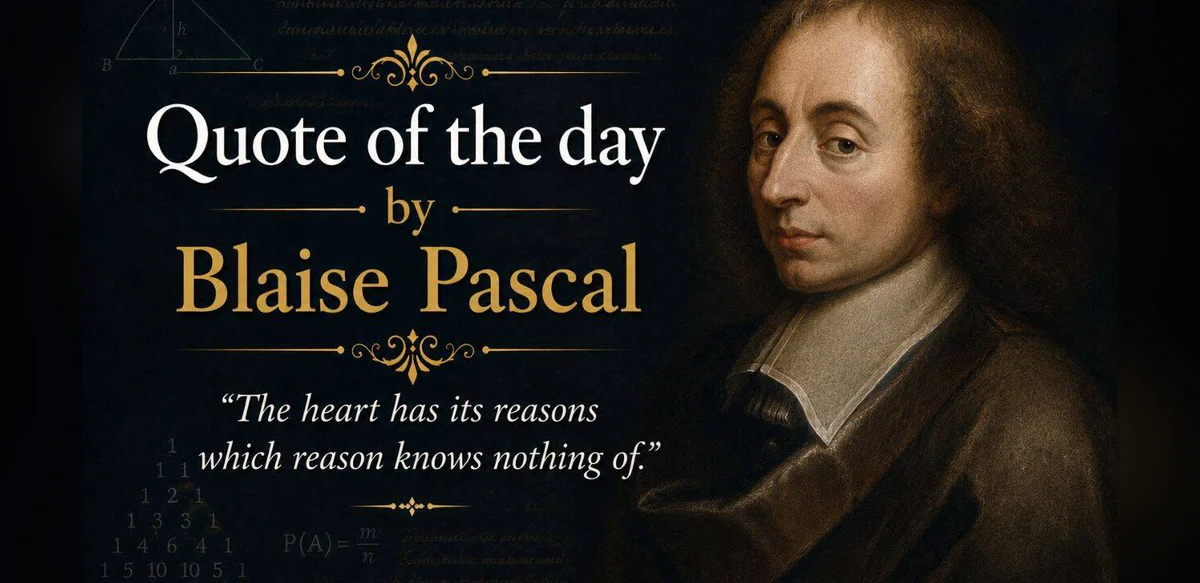
Blaise Pascal once observed that the heart possesses reasons unknown to reason itself. The French mathematician and philosopher, born in 1623, made major contributions to probability theory, geometry and fluid mechanics before focusing on philosophy and faith in later years. His remark appears in Pensées, a posthumously published collection of notes from 1670.
The statement distinguishes two paths to conviction. Reason relies on logic, evidence and arguments that can be shared and verified. The heart, by contrast, yields certainty without requiring a chain of deductions. Pascal, who understood the power of proof, did not reject reason; he simply noted that some forms of knowledge, such as love or faith, do not originate in logic and cannot be fully justified by it.
Contemporary culture often assumes sound choices arise from data and analysis. Yet research in behavioural science shows people frequently reach conclusions through feeling and later assemble supporting reasons. Pascal identified this gap centuries earlier. Because such knowledge resists transfer through explanation, it is easily labelled irrational, even though it may be genuine and valid on its own terms.
Other well-known lines from Pascal include observations on kindness, solitude, the boundaries of reason, and the relationship between justice and power. His words continue to resonate because many people recognise moments when careful argument fails to capture why they feel as they do.

