


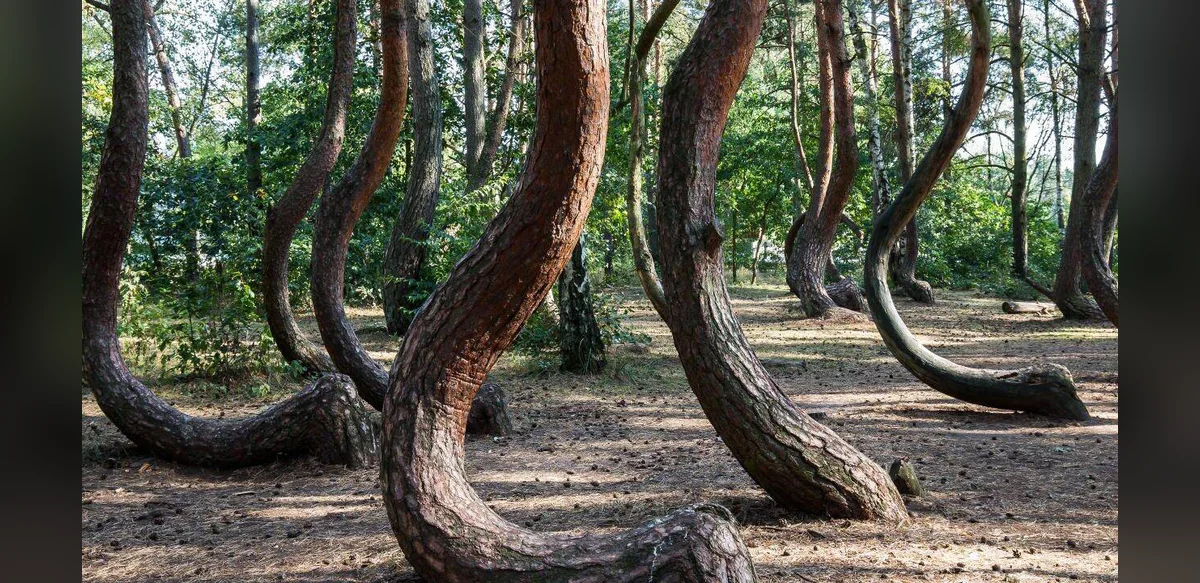
A small woodland area in western Poland features an unusual sight. At first sight it resembles a typical pine grove, yet closer inspection reveals hundreds of trunks that bend sharply near the ground before growing straight upward. This creates a striking collection of J-shaped trees, all curving in roughly the same northerly direction. The surrounding forest grows normally, highlighting the contrast within this limited zone.
The pines were planted in the late 1920s. Historical accounts suggest that any intended shaping work was likely halted by the outbreak of World War II, after which records and local knowledge were lost. Today the site draws visitors and researchers, yet no single explanation has gained broad acceptance.
One leading theory holds that foresters deliberately bent young trunks to create curved timber for furniture or boat building. If started, the project may have been abandoned due to the war. Natural causes such as heavy snow have also been proposed, though the uniform pattern across nearly all affected trees makes weather damage alone unlikely. Less conventional ideas involving gravity or other forces lack scientific support.
The trees survived the bending and continued vertical growth into maturity. With the pines now approaching the end of their lifespan, scientists and conservation groups are increasing efforts to study and protect the grove before the phenomenon disappears.

