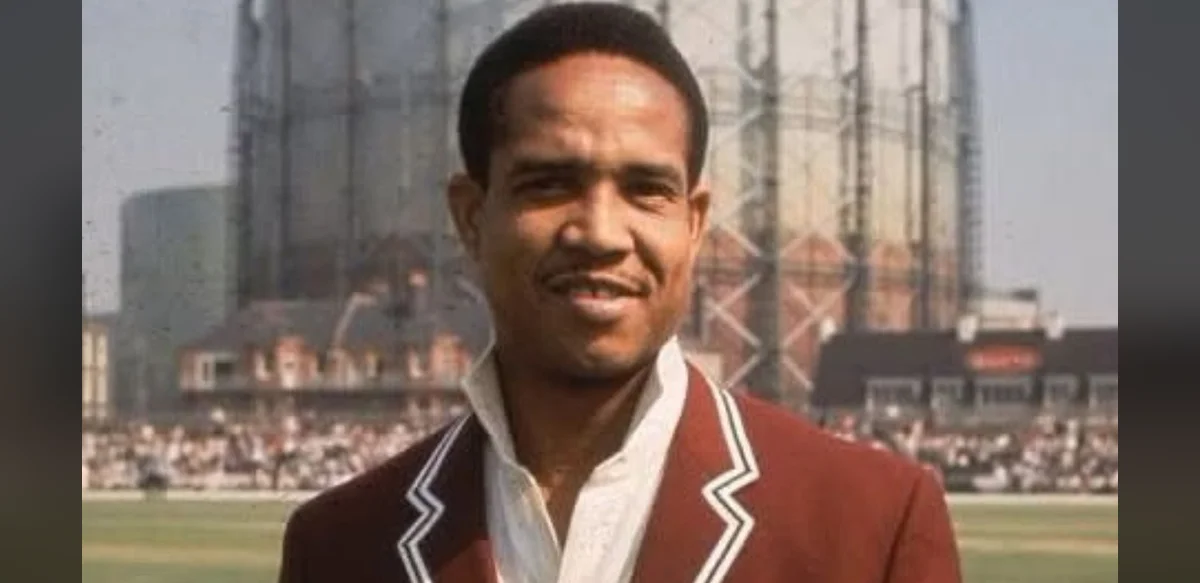
Garry Sobers, who died on Friday, 11 days before turning 90, never fully recognized his own greatness. Charlie Davis, a former West Indies teammate, once described the issue. “He was too modest. He didn’t know how special he was. He expected us to bat like him. And catch like him. He thought all of us were like him,” Davis recalled. “He would come in and say, ‘I will get a 150, Kanhai, you give me a 100, Charlie, you give me a 75’. That was it. That was the plan. No self-doubt.” The plan often succeeded, though only one player could fulfill his part. Salim Durani, the Indian all-rounder who played against him in the 1960s and 1970s, said a few years before his own death in 2023: “What a player he was. And such a simple man.” Sobers was born in July 1936 in a small wooden house on Walcott Avenue in Bridgetown, with an extra finger on each hand. His father, a merchant seaman, died when his ship was torpedoed in January 1942. Sobers was five. At 14, he ran errands in a furniture factory. He received no formal coaching and learned the game through street matches in St Michael. At 21, his first Test century against Pakistan reached 365, surpassing Len Hutton’s world record; it lasted 36 years until Brian Lara broke it. Sobers bowled fast-medium, orthodox spin, wrist-spin, or whatever the situation required. At Swansea in 1968, he struck Malcolm Nash for six sixes in an over, the first such feat in first-class cricket. In 93 Tests, he scored 8,032 runs at 57.78 and took 235 wickets. The figures do not capture the full picture. There was a period when he scored three centuries in a home series against England. The drive came from the death of a friend and teammate for which he felt responsible. In September 1959, driving at night to a London charity match, Sobers met a 10-ton cattle truck on a bend. Fast bowler Tom Dewdney sat in the passenger seat and Collie Smith, his closest friend, slept in the back. Smith’s spine was broken. “Don’t worry about me,” he told Sobers. “Look after the big fellow;” he meant Dewdney. Smith died three days later at age 26. Sobers was fined 10 pounds for careless driving and began drinking, but decided that would be another betrayal. He resolved to bat for two men thereafter, himself and Collie Smith. Charlie Davis, who played under Sobers and observed him closely, once said: “He is not normal. He is definitely not normal.” Davis remained amazed by him. “Garry could catch a blur, you know. He used to be close at leg slip, at the back pocket of the batsman, and catch blurs.” At Melbourne in 1971-72, playing for the World XI, Sobers was dismissed for a duck by a young Dennis Lillee. That evening, Sobers found Ian Chappell in the Australian dressing room. “You’ve got a boy here called Lillee. Tell him I can bowl quick too.” He dismissed Lillee, and Chappell later reported that Lillee had smashed his bat against the wall, insisting he had not yet bowled at full speed. “He’s got the ball, I’ve got the bat,” Sobers said. “I’ve never met the one who can scare me, and I don’t think that I will.” He scored 254, with a straight drive reaching the sightscreen almost before Lillee completed his follow-through. Bradman called it the greatest innings he had seen on Australian soil. At Lord’s in 1973, after a party that ended at half past nine in the morning, Sobers showered, padded up and scored an unbeaten 150. It was his 26th Test century, and his last. “Life is for living,” was his philosophy. He walked when he edged the ball, without waiting for the umpire. He would not tolerate sledging. In the early 1980s, Sobers coached Sri Lanka, when a young Arjuna Ranatunga was beginning his career. Ranatunga recalled a day in England when the ball was seaming and batsmen kept edging. “He stormed across. ‘What are you lot doing? Hey, fat boy! Give me your gloves.’ I offered the bat as well. He brushed me aside and took out a stump. Just a stump, you know. And he played six balls and connected perfectly.” Ranatunga always called him Sir Garry. In February 1975, he was knighted at the Garrison Racecourse, a short distance from the wooden house on Walcott Avenue. In 2000, Wisden named him one of its five Cricketers of the Century.