


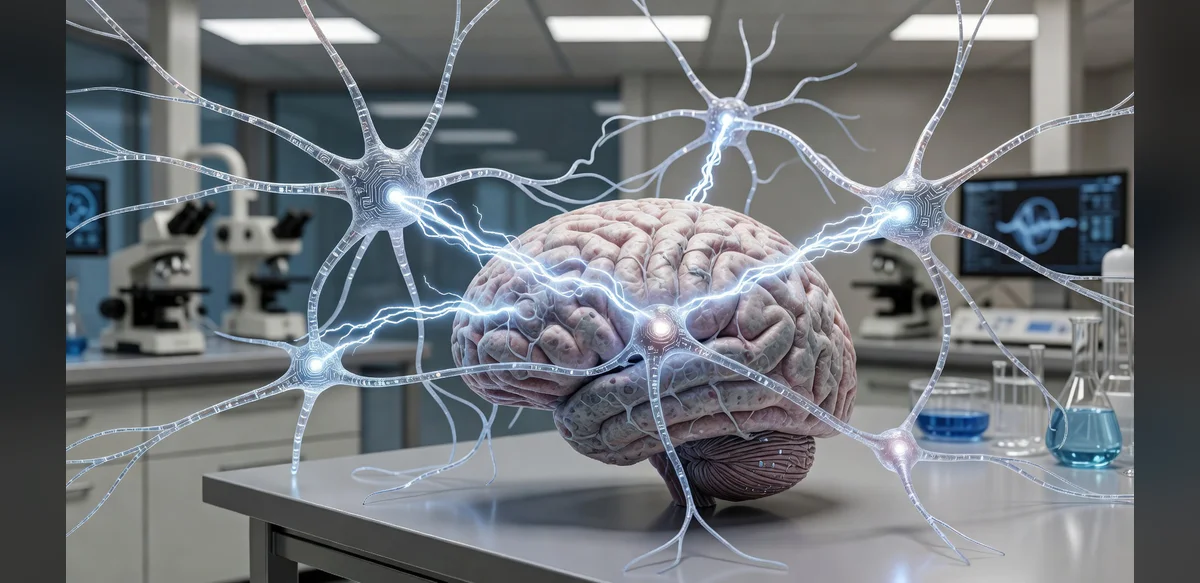
Researchers at Northwestern University have developed printed synthetic neurons capable of more than just mimicking natural ones; they can directly engage with living brain cells. These adaptable, affordable devices emit electrical impulses that mimic those from biological neurons, enabling them to stimulate actual brain tissue.
In tests involving mouse brain sections, the synthetic neurons effectively prompted reactions from genuine neurons. This achievement demonstrates enhanced harmony between electronic tools and organic neural networks.
Advancing Neural Interfaces and Efficient Computing
This breakthrough brings scientists nearer to creating electronics that integrate seamlessly with the nervous system. Possible applications encompass brain-computer interfaces and neural prosthetics, like devices that might aid in recovering hearing, sight, or mobility.
The innovation also suggests pathways for brain-mimicking computing platforms. By emulating neuronal signaling, upcoming hardware could execute intricate operations with much lower energy demands. The human brain stands as the pinnacle of energy-efficient computation, and experts aim to incorporate its mechanisms into contemporary tech.
The research is set for publication on April 15 in Nature Nanotechnology.
“In our current era, artificial intelligence dominates,” noted Mark C. Hersam of Northwestern, who spearheaded the project. “Enhancing AI involves training on vast datasets, which creates substantial energy consumption issues. Thus, we need more effective hardware for managing large data and AI. Given the brain’s vastly superior energy efficiency over digital systems, it’s logical to draw from it for future computing advancements.”
Hersam specializes in brain-inspired computing and occupies several positions at Northwestern, such as the Walter P. Murphy Professor of Materials Science and Engineering in the McCormick School of Engineering. He is also a professor of medicine at the Feinberg School of Medicine and a professor of chemistry in the Weinberg College of Arts and Sciences. Additionally, he chairs the materials science and engineering department, directs the Materials Research Science and Engineering Center, and belongs to the International Institute for Nanotechnology. He co-directed the study alongside Vinod K. Sangwan, a research associate professor at McCormick.
How the Brain Surpasses Conventional Silicon Tech
Contemporary computers manage growing demands by integrating billions of uniform transistors on stiff, flat silicon wafers. Each element functions identically, and the setup stays unchanged post-production.
In contrast, the brain operates through diverse neuron types, each with distinct functions, organized in pliable, three-dimensional webs. These structures evolve continually, forming and refining links during learning processes.
“Silicon gains sophistication via billions of identical units,” Hersam explained. “All are uniform, inflexible, and static after creation. The brain differs: it’s varied, adaptable, and multidimensional. To progress there, we require novel materials and fabrication methods for electronics.”
While synthetic neurons existed previously, most generated basic signals. For sophisticated actions, engineers often needed extensive device arrays, raising energy needs.
Printable Substances Foster Brain-Similar Functions
To more accurately duplicate natural neural patterns, Hersam’s group constructed synthetic neurons from soft, printable substances that better align with brain architecture. Their method uses electronic inks composed of tiny molybdenum disulfide (MoS2) flakes, functioning as a semiconductor, and graphene as a conductor. These were applied to pliable polymer bases via aerosol jet printing.
Earlier, scientists viewed the polymer in these inks as a drawback due to its impact on conductivity, leading to its removal after printing. Here, the team leveraged that trait to improve performance.
“Rather than eliminating the polymer entirely, we break it down partially,” Hersam said. “Then, applying current drives additional breakdown. This happens unevenly, creating a conductive pathway that channels current into a tight area.”
This confined path yields an abrupt electrical output akin to a neuron activating. The device can produce diverse signals, such as individual pulses, steady discharges, and burst sequences, mirroring authentic neural exchanges.
Since each synthetic neuron generates intricate signals, fewer units are required for advanced functions. This approach could greatly

